
The following figures show three curves generated using an iterative algorithm. The total length of the curve generated after 'Iteration n' is:
Note: The figures shown are representative.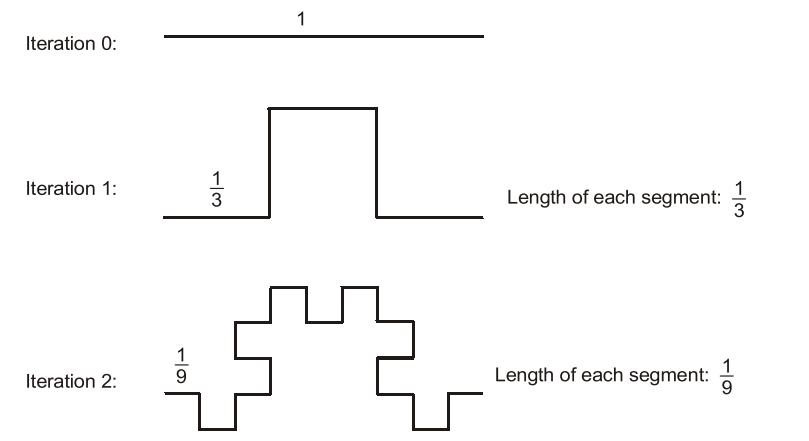
The problem involves calculating the total length of a curve generated through an iterative process. Let's examine how the iterative process affects the length:
Explanation:
Given the figures, it seems that in each iteration, the line segments are divided and modified. This resembles a process like creating a Koch snowflake:
- Initial Condition: At iteration 0, the line is a simple straight line of length 1.
- Iteration 1: The line is divided into 3 parts. For each segment, the middle third is replaced by two segments of equal length, forming a peak. This transformation makes the length of each segment \(\frac{1}{3}\), and the total number of segments becomes 4 times the original number.
- Iteration 2: The process repeats on each segment, increasing the total number of segments once again by 4/3 times the previous length.
Deriving the formula:
With each iteration:
- The total number of segments increases by a factor of \(\frac{4}{3}\).
- The length of each individual segment decreases by a factor of \(\frac{1}{3}\).
Thus, the total length after iteration \(n\) can be expressed as:
\[ L_n = (L_0) \times \left( \frac{4}{3} \right)^n \times \left(\frac{1}{3}\right)^n = (L_0) \times \left(\frac{4}{3} \times \frac{1}{3}\right)^n \]
Since the initial length \(L_0 = 1\), the total length after \(n\) iterations is:
\[ L_n = \left(\frac{5}{3}\right)^n \]
Conclusion:
The correct option is \(\left(\frac{5}{3}\right)^n\), which matches the given configuration.
Important Questions from Series
- In the sequence 6, 9, 14, $x$, 30, 41, a possible value of $x$ is
Let $a_0 = 0$ and define $a_n = \frac{1}{2}(1 + a_{n-1})$ for all positive integers $n \ge 1$.
The least value of $n$ for which $|1 - a_n| < \frac{1}{2^{10}}$ is __________.
(Answer in integer)
- Calculate the reciprocal of the coefficient of $z^3$ in the Taylor series expansion of the function $f(z) = \sin(z)$ around $z = 0$. (Provide the answer as an integer.)
- Let $a_1 = 1$ and $a_n = a_{n-1} + 4$, $n \ge 2$. Then,
$\lim_{n\to\infty} \left[\frac{1}{a_1a_2} + \frac{1}{a_2a_3} + \dots + \frac{1}{a_{n-1}a_n}\right]$
is equal to ________ - Let $S(x) = a_0 + \sum_{n=1}^\infty(a_n \cos (n x) + b_n \sin (n x))$ be the Fourier series of the$2 \pi$ periodic function defined by $f(x) = x^2 + 4 \sin (x) \cos(x)$, $-\pi \le x \le \pi$. Then
$|\sum_{n=0}^\infty a_n - \sum_{n=1}^\infty b_n|$
is equal to ________


