
Understanding Solubility Change
The solubility of sodium bicarbonate changes with temperature. At $60 \text{ }^\circ\text{C}$, it is more soluble ($16.4 \text{ g}$ per $100 \text{ g}$ water) than at $20 \text{ }^\circ\text{C}$ ($9.6 \text{ g}$ per $100 \text{ g}$ water).
Calculating Crystallized Percentage
When a saturated solution at a higher temperature is cooled, the excess dissolved solute crystallizes out if the solubility decreases.
- Initial dissolved amount: Assume we have $100 \text{ g}$ of water. At $60 \text{ }^\circ\text{C}$, a saturated solution contains $16.4 \text{ g}$ of sodium bicarbonate.
- Final dissolved amount: When cooled to $20 \text{ }^\circ\text{C}$, the solution can only hold $9.6 \text{ g}$ of sodium bicarbonate per $100 \text{ g}$ of water.
-
Amount crystallized: The difference between the initial dissolved amount and the final dissolved amount crystallizes out.
Amount crystallized = Initial dissolved amount - Final dissolved amount
Amount crystallized = $16.4 \text{ g} - 9.6 \text{ g} = 6.8 \text{ g}$
-
Percentage crystallized: This is calculated relative to the amount dissolved in the saturated solution at the higher temperature ($60 \text{ }^\circ\text{C}$).
Percentage crystallized = $ (\frac{\text{Amount crystallized}}{\text{Initial dissolved amount at } 60 \text{ }^\circ\text{C}}) \times 100\% $
Percentage crystallized = $ (\frac{6.8 \text{ g}}{16.4 \text{ g}}) \times 100\% \approx 41.46\% $
Therefore, approximately $41.5\%$ of the dissolved salt crystallizes out.
Important Questions from Numerical Computation
- An organization allows its employees to work independently on consultancy projects but charges an overhead on the consulting fee. The overhead is 20% of the consulting fee, if the fee is up to . 5,00,000. For higher fees, the overhead is . 1,00,000 plus 10% of the amount by which the fee exceeds . 5,00,000. The government charges a Goods and Services Tax of 18% on the total amount (the consulting fee plus the overhead). An employee of the organization charges this entire amount, i.e., the consulting fee, overhead, and tax, to the client. If the client cannot pay more than . 10,00,000, what is the maximum consulting fee that the employee can charge?
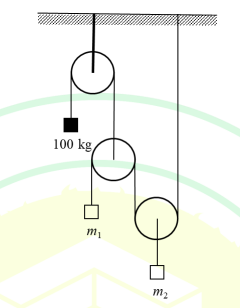
Three frictionless pulleys with rope attachment are in a static equilibrium as shown in the figure. The mass $m_1$ and $m_2$, in kg, respectively are
If the in-situ density of coal is 1320 kg/m$^3$ and the density of blasted coal is 952 kg/m$^3$, the swell factor is _____________ (rounded off to 3 decimal places)
A five-member truss system is shown in the figure. The maximum vertical force P in kN that can be applied so that loads on the member CD and BC do NOT exceed 50 kN and 30 kN, respectively is _____________(rounded off to 2 decimal places)
The Fourier transform and its inverse transform are respectively defined as $\tilde{f}(\omega) = \frac{1}{\sqrt{2\pi}} \int_{-\infty}^{+\infty} f(x)e^{i\omega x}dx$ and $f(x) = \frac{1}{\sqrt{2\pi}} \int_{-\infty}^{+\infty} \tilde{f}(\omega)e^{-i\omega x}d\omega$. Consider two functions $f$ and $g$. Another function $f * g$ is defined as
$(f * g)(x) = \frac{1}{\sqrt{2\pi}} \int_{-\infty}^{+\infty} f(y)g(x - y)dy$
Which of the following relation is/are true?
Note: Tilde ($\sim$) denotes the Fourier transform.


