
Three frictionless pulleys with rope attachment are in a static equilibrium as shown in the figure. The mass $m_1$ and $m_2$, in kg, respectively are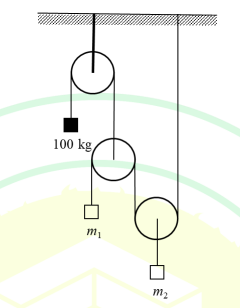
To determine the masses \(m_1\) and \(m_2\), we analyze the forces in static equilibrium with the help of the given pulley system.
In this system, we have:
- A mass of 100 kg attached to the left-most pulley.
- Two other masses \(m_1\) and \(m_2\) attached to the system of pulleys and rope.
The tension in the rope throughout is consistent due to the frictionless nature of the pulleys. Let's define the tension in the rope as \(T\).
- For the 100 kg mass:
- The downward force due to gravity is \(100g\).
- Since the system is in equilibrium, the tension \(T\) in the rope must balance this force: \(T = 100g\).
- Analyzing the mass \(m_1\):
- Considering the tension in the rope, we have \(T = m_1 \times g\), so \(m_1 \times g = 100g\).
- Cancel out \(g\) from both sides to get \(m_1 = 100\) kg.
- Analyzing the mass \(m_2\):
- The tension in the rope supporting \(m_2\) and \(m_1\) is the same, so the effective tension here is shared between two strands of rope: \(T = 2T_1\).\)
- The tension in the rope at \(m_2\) is then \(T_1 = 50g\).\)
- This implies \(m_2 \times g = 50g\), and therefore, \(m_2 = 50\) kg.
The calculated values for the masses are \(m_1 = 100\) kg and \(m_2 = 50\) kg.
Conclusion: The correct option is 50, 100. Thus, the mass \(m_1 = 100\) kg and the mass \(m_2 = 50\) kg.
Important Questions from Numerical Computation
In an engineering college of 10,000 students, 1,500 like neither their core branches nor other branches. The number of students who like their core branches is 1/4th of the number of students who like other branches. The number of students who like both their core and other branches is 500.
The number of students who like their core branches is$A$ is an ($n \times n$) matrix. Consider the following two statements
Statement 1: Columns of matrix $A$ are linearly independent
Statement 2: Inverse of matrix $A$ exists
Which one of the following statements is TRUE?
- Consider the function $G(x, y, z) = 0$. This function allows us to implicitly define each of three variables as a function of the other two variables. Assume that all partial derivatives of the function $G(x, y, z)$ exist everywhere. Then, the value of $\left(\frac{\partial z}{\partial x} \times \frac{\partial x}{\partial y} \times \frac{\partial y}{\partial z}\right)$ is _________ (in integer)
- Levenshtein distance is used to measure the minimum edit distance between two strings by counting the minimum number of editing operations (such as, insertions, deletions, substitutions) required to transform one string to another. Consider an alternative version of the Levenshtein distance in which each insertion and each deletion has a cost of 1 and substitutions are not allowed.
Based on this alternative version, the Levenshtein distance between the strings, word and work is ______ (Answer in integer). - In a given collection of documents, let $N$ be the total number of documents and let $d$ be the number of documents in which the term $t$ occurs.
Which ONE of the following fractions is used to define the inverse document frequency (idf) of the term $t$?


