
Consulting Fee Calculation Basis
The problem requires finding the maximum consulting fee ($CF$) a client can be charged, given a total payment limit of $10,00,000$. This total amount includes the consulting fee, overhead charges ($OH$), and Goods and Services Tax ($GST$).
Defining Key Financial Components
- Consulting Fee ($CF$): The base amount charged for services.
- Overhead ($OH$): An additional charge based on the $CF$.
- Goods and Services Tax ($GST$): A tax levied at 18% on the sum of $CF$ and $OH$.
- Total Chargeable Amount: $CF + OH + GST$.
- Client Limit: The maximum amount the client can pay is $10,00,000$.
Calculating Total Charge
The total amount charged to the client is calculated as follows:
Total Charge = $CF + OH + GST$
Since $GST = 0.18 \times (CF + OH)$, the total charge can be expressed as:
Total Charge = $(CF + OH) + 0.18 \times (CF + OH) = 1.18 \times (CF + OH)$
Given the client's limit:
$1.18 \times (CF + OH) \le 10,00,000$
Therefore, the sum of the consulting fee and overhead must satisfy:
$CF + OH \le \frac{10,00,000}{1.18} \approx 8,47,457.63$
Determining Overhead Structure
The overhead calculation depends on the consulting fee:
- If $CF \le 5,00,000$, $OH = 0.20 \times CF$.
- If $CF > 5,00,000$, $OH = 1,00,000 + 0.10 \times (CF - 5,00,000)$.
To maximize the $CF$ within the $10,00,000$ limit, we anticipate the $CF$ will likely exceed $5,00,000$. Let's use the second overhead formula:
$OH = 1,00,000 + 0.10 \times CF - 50,000$
$OH = 50,000 + 0.10 \times CF$
Maximum Consulting Fee Derivation
Substitute the derived $OH$ into the inequality $CF + OH \le 8,47,457.63$:
$CF + (50,000 + 0.10 \times CF) \le 8,47,457.63$
Combine the $CF$ terms:
$1.10 \times CF + 50,000 \le 8,47,457.63$
Isolate the $CF$ term:
$1.10 \times CF \le 8,47,457.63 - 50,000$
$1.10 \times CF \le 7,97,457.63$
Calculate the maximum $CF$:
$CF \le \frac{7,97,457.63}{1.10}$
$CF \le 7,24,961.48$
The maximum consulting fee the employee can charge is approximately $7,24,961$.
Important Questions from Numerical Computation
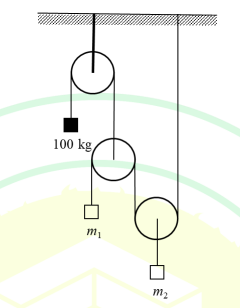
Three frictionless pulleys with rope attachment are in a static equilibrium as shown in the figure. The mass $m_1$ and $m_2$, in kg, respectively are
If the in-situ density of coal is 1320 kg/m$^3$ and the density of blasted coal is 952 kg/m$^3$, the swell factor is _____________ (rounded off to 3 decimal places)
A five-member truss system is shown in the figure. The maximum vertical force P in kN that can be applied so that loads on the member CD and BC do NOT exceed 50 kN and 30 kN, respectively is _____________(rounded off to 2 decimal places)
The Fourier transform and its inverse transform are respectively defined as $\tilde{f}(\omega) = \frac{1}{\sqrt{2\pi}} \int_{-\infty}^{+\infty} f(x)e^{i\omega x}dx$ and $f(x) = \frac{1}{\sqrt{2\pi}} \int_{-\infty}^{+\infty} \tilde{f}(\omega)e^{-i\omega x}d\omega$. Consider two functions $f$ and $g$. Another function $f * g$ is defined as
$(f * g)(x) = \frac{1}{\sqrt{2\pi}} \int_{-\infty}^{+\infty} f(y)g(x - y)dy$
Which of the following relation is/are true?
Note: Tilde ($\sim$) denotes the Fourier transform.The approximate value of the integral
$\int_{2}^{3} \frac{dx}{x}$
using Simpson's rule with $h = 0.5$ is


