
The approximate value of the integral
$\int_{2}^{3} \frac{dx}{x}$
using Simpson's rule with $h = 0.5$ is
Simpson's Rule Integral Approximation
The problem requires approximating the definite integral $\int_{2}^{3} \frac{dx}{x}$ using Simpson's rule with a step size $h = 0.5$. Simpson's rule is a numerical technique for estimating the value of a definite integral.
Simpson's Rule Formula
The general formula for Simpson's rule is:
$ \int_{a}^{b} f(x) dx \approx \frac{h}{3} [f(x_0) + 4f(x_1) + 2f(x_2) + 4f(x_3) + \dots + 2f(x_{n-2}) + 4f(x_{n-1}) + f(x_n)] $
Identify the components:
- Function: $f(x) = \frac{1}{x}$
- Integration limits: $a = 2$, $b = 3$
- Step size: $h = 0.5$
Determine Integration Points
Calculate the number of subintervals, $n$:
$ n = \frac{b-a}{h} = \frac{3-2}{0.5} = \frac{1}{0.5} = 2 $
Since $n=2$ is an even number, Simpson's rule is applicable. The points for evaluation are:
- $x_0 = a = 2$
- $x_1 = a + h = 2 + 0.5 = 2.5$
- $x_2 = a + 2h = 2 + 2(0.5) = 3$
Evaluate Function at Points
Calculate the function values $f(x)$ at the determined points:
- $f(x_0) = f(2) = \frac{1}{2} = 0.5$
- $f(x_1) = f(2.5) = \frac{1}{2.5} = \frac{1}{5/2} = \frac{2}{5} = 0.4$
- $f(x_2) = f(3) = \frac{1}{3}$
Calculate Integral Approximation
Apply Simpson's rule formula with $n=2$:
$ \int_{2}^{3} \frac{dx}{x} \approx \frac{h}{3} [f(x_0) + 4f(x_1) + f(x_2)] $
Substitute the calculated values:
$ \approx \frac{0.5}{3} \left[ 0.5 + 4(0.4) + \frac{1}{3} \right] $
Perform the arithmetic:
$ \approx \frac{0.5}{3} \left[ 0.5 + 1.6 + \frac{1}{3} \right] $
$ \approx \frac{0.5}{3} \left[ 2.1 + \frac{1}{3} \right] $
Combine the terms inside the bracket using fractions:
$ \approx \frac{0.5}{3} \left[ \frac{21}{10} + \frac{1}{3} \right] $
$ \approx \frac{0.5}{3} \left[ \frac{63}{30} + \frac{10}{30} \right] $
$ \approx \frac{0.5}{3} \left[ \frac{73}{30} \right] $
$ \approx \frac{1/2}{3} \times \frac{73}{30} $
$ \approx \frac{1}{6} \times \frac{73}{30} = \frac{73}{180} $
Convert the fraction to a decimal:
$ \frac{73}{180} \approx 0.40555... $
Final Approximation Value
The computed value using Simpson's rule is approximately $0.4056$. Rounding this to two decimal places gives $0.41$.
Important Questions from Numerical Computation
- An organization allows its employees to work independently on consultancy projects but charges an overhead on the consulting fee. The overhead is 20% of the consulting fee, if the fee is up to . 5,00,000. For higher fees, the overhead is . 1,00,000 plus 10% of the amount by which the fee exceeds . 5,00,000. The government charges a Goods and Services Tax of 18% on the total amount (the consulting fee plus the overhead). An employee of the organization charges this entire amount, i.e., the consulting fee, overhead, and tax, to the client. If the client cannot pay more than . 10,00,000, what is the maximum consulting fee that the employee can charge?
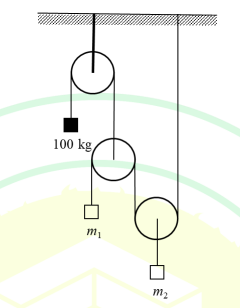
Three frictionless pulleys with rope attachment are in a static equilibrium as shown in the figure. The mass $m_1$ and $m_2$, in kg, respectively are
If the in-situ density of coal is 1320 kg/m$^3$ and the density of blasted coal is 952 kg/m$^3$, the swell factor is _____________ (rounded off to 3 decimal places)
A five-member truss system is shown in the figure. The maximum vertical force P in kN that can be applied so that loads on the member CD and BC do NOT exceed 50 kN and 30 kN, respectively is _____________(rounded off to 2 decimal places)
The Fourier transform and its inverse transform are respectively defined as $\tilde{f}(\omega) = \frac{1}{\sqrt{2\pi}} \int_{-\infty}^{+\infty} f(x)e^{i\omega x}dx$ and $f(x) = \frac{1}{\sqrt{2\pi}} \int_{-\infty}^{+\infty} \tilde{f}(\omega)e^{-i\omega x}d\omega$. Consider two functions $f$ and $g$. Another function $f * g$ is defined as
$(f * g)(x) = \frac{1}{\sqrt{2\pi}} \int_{-\infty}^{+\infty} f(y)g(x - y)dy$
Which of the following relation is/are true?
Note: Tilde ($\sim$) denotes the Fourier transform.


