The set(s) of reagents that will effect the following conversion is(are)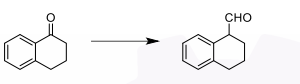
The given conversion involves transforming a carbonyl group (ketone) into an aldehyde. We'll evaluate the sets of reagents to see which can accomplish this transformation.
i) \(\text{Ph}_3\text{P}=\text{CHOMe}\); ii) \(\text{H}_3\text{O}^+\)
This set of reagents implies a Wittig reaction followed by hydrolysis. The Wittig reaction with \(\text{Ph}_3\text{P}=\text{CHOMe}\) forms a new carbon-carbon double bond, which is then hydrolyzed by \(\text{H}_3\text{O}^+\) to yield an aldehyde. This sequence is suitable for converting the ketone group to an aldehyde.
i) \(\text{Me}_3\text{SI}, \text{NaH}\); ii) \(\text{BF}_3 \cdot \text{OEt}_2\)
This combination involves methylation followed by treatment with a Lewis acid. Here, methylation can lead to the formation of a methoxy group, and with the help of \(\text{BF}_3 \cdot \text{OEt}_2\), the intermediate can rearrange to produce an aldehyde. This sequence also achieves the desired conversion.
i) \(\text{TsNHNH}_2\); ii) \({^n}\text{BuLi} \, (2 \, \text{equiv}) \, \text{then} \, \text{DMF}\)
These reagents are typically used for hydrazone formation followed by anion generation and formylation. However, this sequence is less suited for the current conversion of a ketone to an aldehyde without additional steps.
i) \(1,3-\text{dithane}, \, {^n}\text{BuLi}\); ii) \(\text{HgSO}_4, \, \text{dil.} \, \text{H}_2\text{SO}_4\)
This set typically involves dithiane protection followed by hydrolysis to regenerate the carbonyl group. It doesn't directly convert a ketone to an aldehyde under the given conditions.
Thus, the correct sets of reagents that can perform the conversion are:
- \(\text{i) Ph}_3\text{P}=\text{CHOMe}; \text{ ii) H}_3\text{O}^+\)
- \(\text{i) Me}_3\text{SI, NaH; ii) BF}_3 \cdot \text{OEt}_2\)
These options allow the conversion of a ketone to an aldehyde effectively.
Important Questions from Organic Transformations and Reagents
The presence of unsaturation in an organic compound can be detected by
Which of the following boron compounds is used as a reducing agent in organic synthesis?
In elimination reaction of sec-Butyl trimethylammonium hydroxide, major product formed would be ________.
Find out the suitable products in the following Grignard reaction:
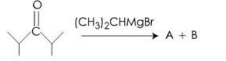
What will be the product in the following reaction ?