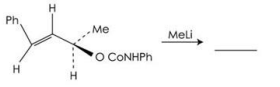
In elimination reaction of sec-Butyl trimethylammonium hydroxide, major product formed would be ________.
1-Butene
Elimination Reaction of sec-Butyl Trimethylammonium Hydroxide
The question asks to identify the major product formed during the elimination reaction of sec-Butyl trimethylammonium hydroxide.
This reaction is a classic example of a Hofmann elimination. Hofmann elimination is a type of \(\text{E}2\) reaction that occurs with quaternary ammonium salts when treated with a strong base like hydroxide (\(\text{OH}^-\)).
Understanding the Hofmann Rule
Unlike typical \(\text{E}2\) reactions of alkyl halides which often follow Zaitsev's rule (favoring the more substituted alkene), Hofmann elimination follows the Hofmann rule. The Hofmann rule states that the major product is the least substituted alkene.
This preference for the least substituted alkene in Hofmann elimination is attributed to the steric bulk of the leaving group (\(\text{-N}^{+}(\text{CH}_3)_3\)) and sometimes the base. The bulky leaving group favors removal of a proton from the least hindered beta carbon, leading to the formation of the least substituted alkene.
Analyzing the Reactant: sec-Butyl Trimethylammonium Hydroxide
The reactant is sec-Butyl trimethylammonium hydroxide. Its structure is:
\(\text{CH}_3\text{-CH}_2\text{-CH}(\text{CH}_3)\text{-N}^{+}(\text{CH}_3)_3 \text{ OH}^{-}\)
The nitrogen atom is attached to the second carbon of the butyl chain (the carbon bearing the ethyl and methyl groups). This carbon is the alpha carbon. The carbons adjacent to the alpha carbon are the beta carbons.
In this molecule, there are two types of beta carbons and associated beta protons:
- The \(\text{CH}_2\) carbon of the ethyl group is a beta carbon. It has two beta protons. Elimination involving these protons leads to a double bond between the alpha carbon and this \(\text{CH}_2\) carbon.
- The \(\text{CH}_3\) carbon is also a beta carbon. It has three beta protons (primary protons). Elimination involving these protons leads to a double bond between the alpha carbon and this \(\text{CH}_3\) carbon.
Predicting the Products
Based on the location of the beta protons, two different alkenes can be formed:
- Removal of a proton from the \(\text{CH}_2\) group leads to 2-Butene: \( \text{CH}_3\text{-CH=CH-CH}_3 \). This is a disubstituted alkene.
- Removal of a proton from the \(\text{CH}_3\) group leads to 1-Butene: \( \text{CH}_3\text{-CH}_2\text{-CH=CH}_2 \). This is a monosubstituted alkene.
Applying the Hofmann Rule to Determine the Major Product
According to the Hofmann rule, the least substituted alkene is the major product in the elimination of quaternary ammonium salts.
- 1-Butene is monosubstituted (one alkyl group attached to the double bond carbons).
- 2-Butene is disubstituted (two alkyl groups attached to the double bond carbons).
Therefore, 1-Butene is the least substituted alkene and will be the major product in the Hofmann elimination of sec-Butyl trimethylammonium hydroxide.
Conclusion
The elimination reaction of sec-Butyl trimethylammonium hydroxide is a Hofmann elimination, which favors the formation of the least substituted alkene. Between the possible products, 1-Butene and 2-Butene, 1-Butene is the least substituted.
Thus, the major product formed is 1-Butene.
Important Questions from Organic Transformations and Reagents
The presence of unsaturation in an organic compound can be detected by
Which of the following boron compounds is used as a reducing agent in organic synthesis?
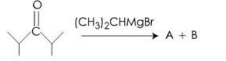
Find out the suitable products in the following Grignard reaction:
What will be the product in the following reaction ?
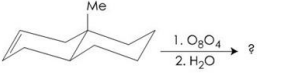
What is the major product in the following reaction?