Which of the following boron compounds is used as a reducing agent in organic synthesis?
LiBH4
Identifying Boron Reducing Agents
In organic synthesis, reducing agents are compounds that donate electrons to another molecule, causing it to be reduced. Boron compounds are known for their diverse reactivity, including their use as reducing agents.
Analyzing the Options
Let's look at the given boron compounds and their common uses:
- $\text{B}_2\text{H}_6$ (Diborane): Diborane is a strong reducing agent. It is particularly effective in reducing carboxylic acids and esters to primary alcohols, reactions that are often difficult with milder reducing agents like sodium borohydride. It can also reduce nitriles and amides.
- $\text{LiBH}_4$ (Lithium borohydride): Lithium borohydride is a milder reducing agent compared to lithium aluminum hydride ($\text{LiAlH}_4$) or diborane ($\text{B}_2\text{H}_6$). It is commonly used to reduce aldehydes and ketones to alcohols. It can also reduce acyl chlorides, esters, and epoxides, though it is less reactive towards these functional groups than $\text{LiAlH}_4$. Its solubility in ethers and tetrahydrofuran makes it a versatile reagent.
- $\text{H}_3\text{BO}_3$ (Boric acid): Boric acid is an acidic compound derived from boron. It is primarily used as an antiseptic, insecticide, flame retardant, and in the manufacture of fiberglass and ceramics. It does not function as a reducing agent in typical organic synthesis reactions; rather, it can sometimes be involved in reaction workups or as a catalyst component.
Comparing Reducing Power and Application
Both diborane ($\text{B}_2\text{H}_6$) and lithium borohydride ($\text{LiBH}_4$) act as reducing agents in organic synthesis. However, they have different reactivities and applications.
Lithium borohydride ($\text{LiBH}_4$) is a widely recognized and frequently used reducing agent for functional groups like aldehydes, ketones, esters, and epoxides, making it a standard reagent in many organic reactions. Diborane is also a potent reducing agent with specific uses, particularly for reducing carboxylic acids and esters.
Given the options, both $\text{B}_2\text{H}_6$ and $\text{LiBH}_4$ are used as reducing agents. However, the question asks for "Which of the following", implying a single or specific widely recognized compound from the list. Lithium borohydride ($\text{LiBH}_4$) is a very common and versatile reducing agent taught in introductory organic chemistry related to hydride reductions.
Conclusion
Based on their common applications in organic synthesis, both $\text{B}_2\text{H}_6$ and $\text{LiBH}_4$ are used as reducing agents. However, lithium borohydride ($\text{LiBH}_4$) is a fundamental and widely applicable hydride reducing agent for various functional groups, making it a primary example of a boron compound used for reduction.
Important Questions from Organic Transformations and Reagents
The presence of unsaturation in an organic compound can be detected by
In elimination reaction of sec-Butyl trimethylammonium hydroxide, major product formed would be ________.
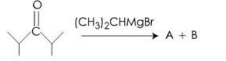
Find out the suitable products in the following Grignard reaction:
What will be the product in the following reaction ?
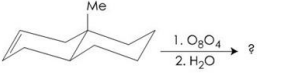
What is the major product in the following reaction?