What will be the product in the following reaction ?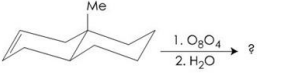
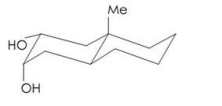
The reaction depicted involves the use of osmium tetroxide (OsO4) followed by water (H2O) in the reaction sequence. This is a classic example of syn-dihydroxylation, where a pair of hydroxyl (OH) groups are added to the same side (syn addition) of the double bond in an alkene.
Here's the step-by-step reasoning for the transformation:
- The reactant molecule has a double bond, which acts as the site for the syn-dihydroxylation reaction.
- In the presence of OsO4, the double bond will coordinate with the osmium, forming a cyclic osmate ester intermediate.
- Addition of water (H2O) leads to hydrolysis of this intermediate, resulting in the syn addition of two hydroxyl groups across the former double bond.
- The stereochemistry of the molecule is preserved in a syn addition, meaning both new hydroxyl groups are added to the same face of the double bond.
This transformation converts the alkene to a vicinal diol (glycol), where the OH groups are on adjacent carbon atoms.
Given this reaction mechanism, the correct product from the provided options is the one showing the syn-diol formation.
The correct answer is thus represented by the image above.
Important Questions from Organic Transformations and Reagents
The presence of unsaturation in an organic compound can be detected by
Which of the following boron compounds is used as a reducing agent in organic synthesis?
In elimination reaction of sec-Butyl trimethylammonium hydroxide, major product formed would be ________.
Find out the suitable products in the following Grignard reaction:
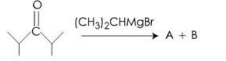
What is the major product in the following reaction?