
Type-I Superconductor Magnetic Properties
Type-I superconductors exhibit a phenomenon known as the Meissner effect. This effect means they completely expel external magnetic fields from their interior when transitioning into the superconducting state.
Meissner Effect and Diamagnetism
Complete expulsion of a magnetic field is characteristic of perfect diamagnetism. The magnetic susceptibility (${\chi_m}$) quantifies a material's response to an external magnetic field. For perfect diamagnetism, the magnetic susceptibility is:
$ \chi_m = -1 $
Calculating Relative Magnetic Permeability
The relative magnetic permeability (${\mu_r}$) is related to the magnetic susceptibility by the formula:
$ \mu_r = 1 + \chi_m $
Substituting the value of susceptibility for a perfect diamagnet (as exhibited by type-I superconductors due to the Meissner effect):
$ \mu_r = 1 + (-1) $
$ \mu_r = 0 $
Therefore, the relative magnetic permeability of a type-I superconductor is 0.
Important Questions from Superconductivity Meissner Effect BCS Theory
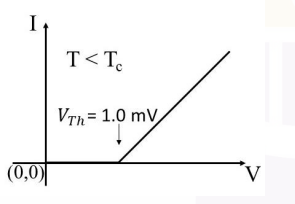
Consider a metal-superconductor junction connected to a dc voltage $V$. At $T < T_c$, where $T_c$ is the superconductor's transition temperature, the current $I$ versus $V$ behavior of this junction is shown schematically in the figure below. If the superconducting energy gap is $D \text{ meV}$. The value of $D$ (rounded off to one decimal place) is _____
- Which of the following option(s) is/are correct for a Type I superconductor?
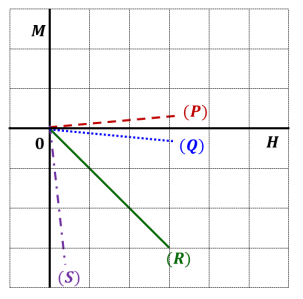
The figure schematically shows the $M$ (magnetization) - $H$ (magnetic field) plots for certain types of materials. Here $M$ and $H$ are plotted in the same scale and units. Which one of the following is the most appropriate combination?
- A material behaves as a superconductor below a critical temperature $T_c$ and as a normal conductor above $T_c$. A magnetic field $\vec{B} = B\hat{z}$ is applied when $T > T_c$. The material is then cooled below $T_c$ in the presence of $\vec{B}$. Which of the following figure represent the correct configuration of magnetic field lines?
- Amongst electrical resistivity ($\rho$), thermal conductivity ($\kappa$), specific heat ($C$), Young's modulus ($Y$), and magnetic susceptibility ($\chi$), which quantities show a sharp change at the superconducting transition temperature?


