
The reaction that proceeds through an oxidative addition followed by a reductive elimination is
[Given: Atomic numbers Ni = 28, Ta = 73, Zr = 40, Pt = 78]
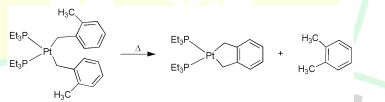
Mechanism Analysis: Oxidative Addition and Reductive Elimination
The question asks to identify a reaction proceeding via oxidative addition followed by reductive elimination. These are key steps in many organometallic catalytic cycles.
- Oxidative Addition involves an increase in the metal's oxidation state (usually by two) and coordination number.
- Reductive Elimination involves a decrease in the metal's oxidation state (usually by two) and coordination number, forming a new bond between ligands.
Evaluating Reaction Schemes
Let's analyze the provided reaction images:
- Option 1 (Ni): Shows a nickel-catalyzed reaction, likely coupling.
- Option 2 (Ta): Shows a tantalum-mediated reaction.
- Option 3 (Zr): Shows a zirconium-catalyzed reaction.
- Option 4 (Pt): This scheme depicts a catalytic cycle starting with a Platinum (Pt) complex, presumably in a low oxidation state (e.g., Pt(0)). The reaction involves:
- The addition of an R-X species across the metal center, leading to an increase in the metal's oxidation state (e.g., to Pt(II)) - this is oxidative addition.
- Subsequent steps lead to the formation of an R-R bond, accompanied by a decrease in the metal's oxidation state back to the initial state (e.g., Pt(0)) - this is reductive elimination.
Conclusion
The reaction scheme presented in Option 4 clearly illustrates a catalytic cycle driven by the fundamental steps of oxidative addition followed by reductive elimination, commonly observed in cross-coupling reactions catalyzed by metals like platinum.
Important Questions from Organometallic Chemistry
The heptacity of allyl and Cp and the ligation mode of NO in the thermodynamically stable complexes
$[(\eta^x-allyl)Ru(CO)_2(NO)]$ and $[(\eta^y-Cp)Ru(CO)_2(NO)]$,
respectively, are
(The heptacity of allyl and Cp are denoted by $\eta^x$ and $\eta^y$, respectively.)The hapticity of cycloheptatriene, $(C_7H_8)$, in $Mo(C_7H_8)(CO)_3$ is ______________.
The bond angle (Ti-C-C) in the crystal structure of
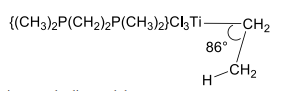
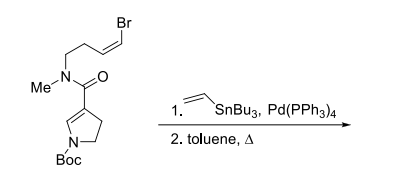
is severely distorted due toThe major product of the following reaction sequence is
Decarbonylation reaction of $[cis-(CH_3CO)Mn(^{13}CO)(CO)_4]$ yields X,Y and Z, where $X =[(CH_3)Mn(CO)_5]$; $Y = [cis-(CH_3)Mn(^{13}CO)(CO)_4]$; $Z = [trans-(CH_3)Mn(^{13}CO)(CO)_4]$
The molar ratio of the products(X : Y : Z) in this reaction is


