The radius of a circle is 13 cm and the length of one of its chords is 10 cm. What is the distance of the chord from the centre?
12 cm
The perpendicular drawn from the centre of a circle to a chord bisects the chord.
So half of the chord length = 10/2 = 5 cm.
Let d be the distance of the chord from the centre. Using the Pythagorean theorem in the right triangle formed by the radius, half-chord and the perpendicular distance: d^2 + 5^2 = 13^2.
d^2 = 169 - 25 = 144, so d = 12 cm.
Important Questions from Circles, Chords and Tangents
A chord 21 cm long is drawn in a circle of diameter 25 cm. The perpendicular distance of the chord from the centre is:
AB is a chord of a circle with centre O and P is any point on the circle. If ∠APB = 112°, then what is the measure of ∠OAB ?
The distance between the centres of two circles is 24 cm. If the radius of the two circles are 4 cm and 8 cm, then what is the sum of the lengths (in cm) of the direct common tangent and the transverse common tangent?
An equilateral triangle ABC and a scalene triangle DBC are inscribed in a circle on same side of the arc. what is ∠BDC equal to?
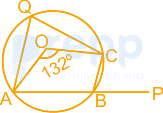
In a circle with centre O, an arc ABC subtends an angle of 132° at the center of the circle. Chord AB is produced to point P. Then ∠CBP is equal to∶