In an equilateral triangle of side 24 cm, a circle is inscribed touching its sides. Find area of remaining portion of the triangle (Take √3 = 1.732).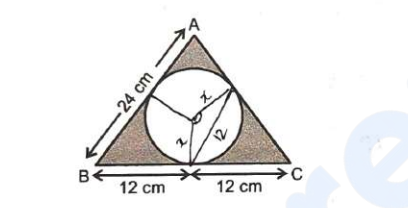
98.55 cm²
Area of the equilateral triangle of side 24 cm is \(\frac{\sqrt3}{4}(24)^2 = 144\sqrt3 = 144\times1.732 = 249.408\ \text{cm}^2\).
The inradius of an equilateral triangle of side \(a\) is \(r=\dfrac{a}{2\sqrt3}\); for \(a=24\), \(r=\dfrac{24}{2\sqrt3}=4\sqrt3\ \text{cm}\), so \(r^2=48\).
Area of the inscribed circle is \(\pi r^2 = 48\pi\); using \(\pi=22/7\), this equals \(48\times\frac{22}{7}=\frac{1056}{7}\approx150.857\ \text{cm}^2\).
Area of the remaining (shaded) portion = area of triangle − area of circle \(= 249.408-150.857 = 98.551\approx98.55\ \text{cm}^2\).
Similar Questions
In a \(\triangle ABC\), \(\angle A:\angle B:\angle C=2:3:4\). A line (l) is drawn parallel to BA, then the \(\angle ACD\) is:
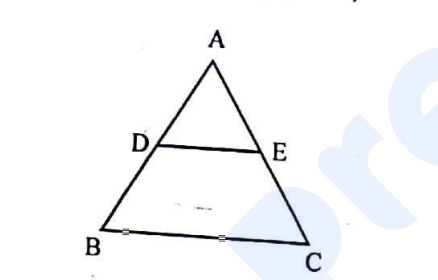
In the given \(\triangle ABC\), \(DE\parallel BC\). If \(BC=8\) cm, \(DE=6\) cm and area of \(\triangle ADE=90\) cm², then what is the area of \(\triangle ABC\) (in cm²)?
Important Questions from Triangles
In a Δ ABC, if ∠A = 120° and AB = AC, then the values of ∠B and ∠C are respectively:
The product of the perimeter of a triangle, the radius of its in‐circle, and a number gives the area of the triangle. The number is
In ∆ABC, 2∠A = 3∠B = 6∠C. What is the value of the largest angle among these three angles?
The longest side in a right-angled triangle is called :
The sum of two sides of a triangle with the third side is