In the given \(\triangle ABC\), \(DE\parallel BC\). If \(BC=8\) cm, \(DE=6\) cm and area of \(\triangle ADE=90\) cm², then what is the area of \(\triangle ABC\) (in cm²)?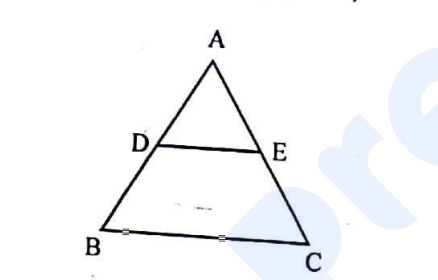
160
Since \(DE\parallel BC\), triangles ADE and ABC are similar with ratio \(\frac{DE}{BC}=\frac{6}{8}=\frac{3}{4}\). The ratio of areas of similar triangles equals the square of the ratio of sides, so \(\frac{[ADE]}{[ABC]}=\frac{9}{16}\), giving \([ABC]=90\times\frac{16}{9}=160\) cm². No handwritten mark was visible on this question in the source sheet, so this answer is based purely on independent calculation.
Similar Questions
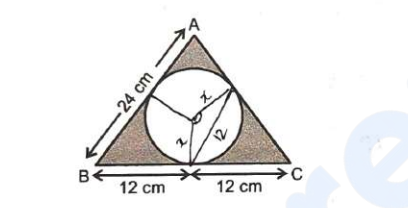
In an equilateral triangle of side 24 cm, a circle is inscribed touching its sides. Find area of remaining portion of the triangle
(Take √3 = 1.732).
In a \(\triangle ABC\), \(\angle A:\angle B:\angle C=2:3:4\). A line (l) is drawn parallel to BA, then the \(\angle ACD\) is:
Important Questions from Triangles
In a Δ ABC, if ∠A = 120° and AB = AC, then the values of ∠B and ∠C are respectively:
The product of the perimeter of a triangle, the radius of its in‐circle, and a number gives the area of the triangle. The number is
In ∆ABC, 2∠A = 3∠B = 6∠C. What is the value of the largest angle among these three angles?
The longest side in a right-angled triangle is called :
The sum of two sides of a triangle with the third side is