
Understanding Heat Treatment Effects on Material Properties
Heat treatment processes alter a material's microstructure by controlled heating and cooling cycles. This modification influences several mechanical properties:
- Yield Strength and Ultimate Tensile Strength: These properties represent a material's resistance to deformation and fracture under tension. Heat treatments like annealing, quenching, and tempering can significantly increase or decrease strength by changing grain size, phase distribution, and introducing internal stresses or precipitates.
- Ductility: This is the ability of a material to deform under tensile stress without fracturing. Heat treatment affects ductility inversely to strength; processes that increase strength often decrease ductility, and vice versa. For example, annealing generally increases ductility.
- Elastic Modulus: Also known as Young's modulus, this property measures a material's stiffness or resistance to elastic deformation. It is primarily determined by the interatomic bonding forces within the material's crystal lattice.
Why Elastic Modulus Remains Unchanged
Common heat treatment procedures do not significantly alter the fundamental nature of atomic bonding or the basic crystal structure responsible for the elastic modulus. While minor changes in microstructure can occur, their effect on the elastic modulus is typically negligible compared to the significant changes observed in strength and ductility. Therefore, the elastic modulus is the property least affected by heat treatment.
The correct answer is Option D.
Important Questions from Heat Treatment Quenching Critical Cooling Rate
- Which of the following statements is/are CORRECT when Ni is added as an alloying element to a low alloy steel?
- In a Jominy end-quench test of the eutectoid plain-carbon steel, which of the following represents the sequence of microstructures observed from the quenched end of the specimen?
- Which one of the following is the correct decreasing sequence of Quenching Power for quenchants used in heat treatment of steels?
- Which one of the following techniques does NOT require quenching to obtain final case hardness?
The microstructures of a quenched steel tempered at three temperatures $T_1 < T_2 < T_3$ for a fixed time are schematically illustrated. The solid circles represent cementite particles in ferrite matrix; $\bar{r}_1, \bar{r}_2$ and $\bar{r}_3$ are average radii of cementite particles, and $V_1, V_2$ and $V_3$ are volume fractions of cementite at temperatures $T_1, T_2$ and $T_3$, respectively.
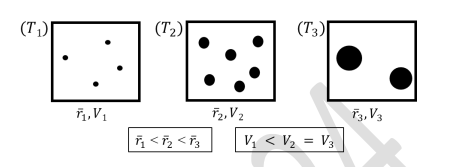
If the cementite in steel is more noble than ferrite, then which one of the three microstructures will have the highest corrosion rate when exposed to an aqueous solution of $3.5 \text{ wt.\% NaCl}$?


