
Superconductor Energy Gap Magnitude
The energy gap in a superconductor, often denoted as '$ \Delta $', represents the minimum energy required to break a Cooper pair (two electrons bound together) or create an excitation above the superconducting state. This gap is a fundamental property that distinguishes superconducting materials from normal conductors.
Typical Energy Gap Values
Based on established theories like the Bardeen-Cooper-Schrieffer (BCS) theory and experimental observations:
- The energy gap is typically very small.
- It is temperature-dependent, decreasing as the temperature approaches the critical temperature ($ T_c $).
- For most conventional superconductors, the energy gap ($ \Delta(0) $) at absolute zero (0 Kelvin) falls in the range of milli-electronvolts (meV).
Comparing Options
Let's examine the given options in the context of typical superconductor energy gaps:
- 1 MeV (Mega-electronvolt): This energy is extremely high, typical for nuclear physics, not condensed matter phenomena like superconductivity.
- 1 KeV (Kilo-electronvolt): This energy is also significantly large for superconductor energy gaps, more characteristic of atomic or high-energy processes.
- 1 eV (electronvolt): While closer, this is generally larger than the typical energy gap for most common superconductors. Some exotic materials might approach this, but it's not the order of magnitude for a *typical* case.
- 1 meV (milli-electronvolt): This value falls directly within the expected and experimentally observed range for the energy gap of typical superconductors at low temperatures. For instance, for lead, $ \Delta(0) \approx 1.4 $ meV.
Therefore, the order of magnitude for the energy gap of a typical superconductor is best represented by 1 meV.
Important Questions from Superconductivity Meissner Effect BCS Theory
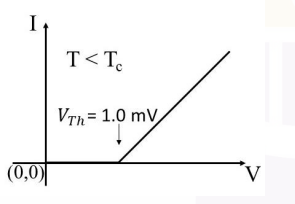
Consider a metal-superconductor junction connected to a dc voltage $V$. At $T < T_c$, where $T_c$ is the superconductor's transition temperature, the current $I$ versus $V$ behavior of this junction is shown schematically in the figure below. If the superconducting energy gap is $D \text{ meV}$. The value of $D$ (rounded off to one decimal place) is _____
- Which of the following option(s) is/are correct for a Type I superconductor?
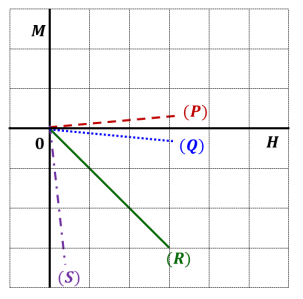
The figure schematically shows the $M$ (magnetization) - $H$ (magnetic field) plots for certain types of materials. Here $M$ and $H$ are plotted in the same scale and units. Which one of the following is the most appropriate combination?
- A material behaves as a superconductor below a critical temperature $T_c$ and as a normal conductor above $T_c$. A magnetic field $\vec{B} = B\hat{z}$ is applied when $T > T_c$. The material is then cooled below $T_c$ in the presence of $\vec{B}$. Which of the following figure represent the correct configuration of magnetic field lines?
- Amongst electrical resistivity ($\rho$), thermal conductivity ($\kappa$), specific heat ($C$), Young's modulus ($Y$), and magnetic susceptibility ($\chi$), which quantities show a sharp change at the superconducting transition temperature?


