The motion of a mass on a spring, with spring constant K is as shown in figure. The equation of motion is given by $x(t) = A\sin\omega t+B\cos\omega t$ with $\omega=\sqrt{\frac{K}{m}}$. Suppose that at time $t = 0$, the position of mass is $x(0)$ and velocity $v(0)$, then its displacement can also be represented as $x(t) = C\cos(\omega t-\phi)$, where $C$ and $\phi$ are
Mass on Spring Motion Equation Analysis
The motion of a mass on a spring is described by the equation $x(t) = A\sin(\omega t) + B\cos(\omega t)$. This solution explains how to represent this motion in the amplitude-phase form $x(t) = C\cos(\omega t - \phi)$, determining the expressions for amplitude $C$ and phase angle $\phi$ using initial conditions $x(0)$ and $v(0)$.
Deriving Amplitude and Phase Angle
Step 1: Determine coefficients $A$ and $B$ from initial conditions.
First, find the velocity equation by differentiating the position equation $x(t)$ with respect to time ($t$):
$v(t) = \frac{dx}{dt} = \frac{d}{dt}(A\sin(\omega t) + B\cos(\omega t)) = A\omega\cos(\omega t) - B\omega\sin(\omega t)$Now, apply the given initial conditions at $t=0$:
- For position: $x(0) = A\sin(0) + B\cos(0)$. Since $\sin(0)=0$ and $\cos(0)=1$, this simplifies to $x(0) = B$.
- For velocity: $v(0) = A\omega\cos(0) - B\omega\sin(0)$. Since $\cos(0)=1$ and $\sin(0)=0$, this simplifies to $v(0) = A\omega$.
From these results, we find the coefficients $B = x(0)$ and $A = \frac{v(0)}{\omega}$.
Substituting these back into the original position equation gives the motion in terms of initial conditions:
$x(t) = \frac{v(0)}{\omega}\sin(\omega t) + x(0)\cos(\omega t)$Step 2: Relate to the amplitude-phase form $x(t) = C\cos(\omega t - \phi)$.
The amplitude-phase form uses the cosine difference identity: $\cos(\alpha - \beta) = \cos\alpha\cos\beta + \sin\alpha\sin\beta$. Applying this:
$x(t) = C(\cos(\omega t)\cos\phi + \sin(\omega t)\sin\phi)$ $x(t) = (C\cos\phi)\cos(\omega t) + (C\sin\phi)\sin(\omega t)$By comparing this expanded form with the equation derived in Step 1 ($x(t) = x(0)\cos(\omega t) + \frac{v(0)}{\omega}\sin(\omega t)$), we can equate the coefficients of $\cos(\omega t)$ and $\sin(\omega t)$:
- Coefficient of $\cos(\omega t)$: $C\cos\phi = x(0)$
- Coefficient of $\sin(\omega t)$: $C\sin\phi = \frac{v(0)}{\omega}$
Step 3: Calculate the amplitude $C$.
To find $C$, we square both equations from Step 2 and add them together:
$(C\cos\phi)^2 + (C\sin\phi)^2 = (x(0))^2 + \left(\frac{v(0)}{\omega}\right)^2$Factor out $C^2$ and use the trigonometric identity $\cos^2\phi + \sin^2\phi = 1$:
$C^2(\cos^2\phi + \sin^2\phi) = x(0)^2 + \frac{v(0)^2}{\omega^2}$ $C^2(1) = x(0)^2 + \frac{v(0)^2}{\omega^2}$ $C^2 = x(0)^2 + \frac{v(0)^2}{\omega^2}$Taking the square root (and assuming amplitude $C$ is non-negative), we get the expression for the amplitude:
$C = \sqrt{x(0)^2 + \frac{v(0)^2}{\omega^2}}$Step 4: Calculate the phase angle $\phi$.
To find $\phi$, we divide the equation for $C\sin\phi$ by the equation for $C\cos\phi$ from Step 2:
$\frac{C\sin\phi}{C\cos\phi} = \frac{v(0)/\omega}{x(0)}$The $C$ terms cancel out, and using $\frac{\sin\phi}{\cos\phi} = \tan\phi$:
$\tan\phi = \frac{v(0)}{x(0)\omega}$Solving for $\phi$ gives the expression for the phase angle:
$\phi = \tan^{-1}\left(\frac{v(0)}{x(0)\omega}\right)$The derived expressions for amplitude $C$ and phase angle $\phi$ are thus obtained.
Similar Questions
- Two tuning forks $A$ and $B$ are sounded together giving rise to $8$ beats in $2\text{ s}$. When fork $A$ is loaded with wax, the beat frequency is reduced to $4$ beats in $2\text{ s}$. If the original frequency of tuning fork $B$ is $380\text{ Hz}$ then original frequency of tuning fork $A$ is _________ $\text{Hz}$.
- A simple pendulum of string length 30 cm performs 20 oscillations in 10 s. The length of the string required for the pendulum to perform 40 oscillations in the same time duration is ___________ cm. [Assume that the mass of the pendulum remains same.]
- The velocity of sound in air is doubled when the temperature is raised from $0^\circ\text{C}$ to $\alpha^\circ\text{C}$. The value of $\alpha$ is ________.
- The velocity of a particle executing simple harmonic motion along $x$-axis is described as $v^2 = 50 - x^2$, where $x$ represents displacement. If the time period of motion is $\frac{x}{7}~\text{s}$, the value of $x$ is ________.
- 5 beats/second are heard when a turning fork is sounded with a sonometer wire under tension, when the length of the sonometer wire is either 0.95 m or 1 m. The frequency of the fork will be
Two simple harmonic motions, as shown below, are at right angles. They are combined to form lissajous figures.
$x(t) = A \sin (at + \delta)$
$y(t) = B \sin (bt)$
Identify the correct match below :
- $T_0$ is the time period of a simple pendulum at a place. If the length of the pendulum is reduced to $\frac{1}{16}$ times of its initial value, the modified time period is
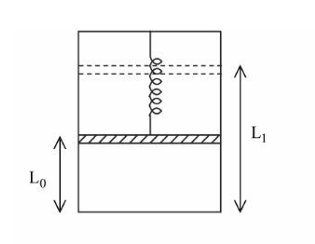
A piston of mass $M$ is hung from a massless spring whose restoring force law goes as $F= -kx^3$, where $k$ is the spring constant of appropriate dimension. The piston separates the vertical chamber into two parts, where the bottom part is filled with 'n' moles of an ideal gas. An external work is done on the gas isothermally (at a constant temperature $T$) with the help of a heating filament (with negligible volume) mounted in lower part of the chamber, so that the piston goes up from a height $L_0$ to $L_1$, the total energy delivered by the filament is : (Assume spring to be in its natural length before heating)
- Two harmonic waves moving in the same direction superimpose to form awave $x = a \cos (1.5t) \cos (50.5t)$ where $t$ is in seconds. Find the period with which they beat.(close to nearest integer)
- A sinusoidal wave of wavelength 7.5 cm travels a distance of 1.2 cm along the x-direction in 0.3 sec. The crest P is at x=0 at t=0 sec and maximum displacement of the wave is 2 cm. Which equation correctly represents this wave ?
Important Questions from Oscillations and Waves
- Two tuning forks $A$ and $B$ are sounded together giving rise to $8$ beats in $2\text{ s}$. When fork $A$ is loaded with wax, the beat frequency is reduced to $4$ beats in $2\text{ s}$. If the original frequency of tuning fork $B$ is $380\text{ Hz}$ then original frequency of tuning fork $A$ is _________ $\text{Hz}$.
- A simple pendulum of string length 30 cm performs 20 oscillations in 10 s. The length of the string required for the pendulum to perform 40 oscillations in the same time duration is ___________ cm. [Assume that the mass of the pendulum remains same.]
- The velocity of sound in air is doubled when the temperature is raised from $0^\circ\text{C}$ to $\alpha^\circ\text{C}$. The value of $\alpha$ is ________.
- The equation of a transverse wave is $y = y_0 \sin 2\pi(ft - \frac{x}{\lambda})$. If the maximum particle velocity be four times that of wave velocity then
- The velocity of a particle executing simple harmonic motion along $x$-axis is described as $v^2 = 50 - x^2$, where $x$ represents displacement. If the time period of motion is $\frac{x}{7}~\text{s}$, the value of $x$ is ________.