
The most stable conformation of the following is
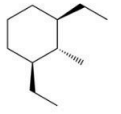
This question asks us to identify the most stable conformation among the given options, which represent different arrangements of substituents on a cyclohexane ring. Understanding cyclohexane conformation is key to determining stability.
Cyclohexane Stability Explained
Cyclohexane exists predominantly in a chair conformation, which is the most stable due to minimal angle strain and torsional strain. In the chair conformation, carbon-hydrogen bonds (and carbon-substituent bonds) can be classified as either axial or equatorial.
- Axial bonds are parallel to the axis passing through the center of the ring.
- Equatorial bonds are roughly perpendicular to this axis and lie closer to the plane of the ring.
The stability of different conformations is primarily influenced by steric factors, particularly 1,3-diaxial interactions. When a substituent is in an axial position, it can experience repulsive interactions with other axial groups on the same side of the ring, typically located at the 1,3-positions relative to it. These $1,3$-diaxial interactions cause steric strain, making the conformation less stable.
Substituents generally prefer to occupy the equatorial position because it minimizes these $1,3$-diaxial interactions. The larger the substituent, the greater the energy cost associated with placing it in an axial position. This preference is quantified by the A-value, which represents the difference in free energy between the equatorial and axial conformers of a monosubstituted cyclohexane.
Stability Analysis of Given Conformations
The provided images illustrate different possible conformations, likely for disubstituted cyclohexanes. We need to compare the stability based on the positions of the substituents (axial or equatorial).
| Conformation Type (Example) | Substituent Positions Shown | Steric Strain | Relative Stability |
| Diaxial (e.g., trans-1,4) | Both substituents axial | High (significant $1,3$-diaxial interactions) | Least Stable |
| Axial-Equatorial (e.g., cis-1,3 or trans-1,2) | One substituent axial, one equatorial | Moderate (some $1,3$-diaxial interactions involving the axial substituent) | Intermediate Stability |
| Diequatorial (e.g., cis-1,3 or trans-1,4) | Both substituents equatorial | Minimal (minimal $1,3$-diaxial interactions) | Most Stable |
Based on the analysis:
- Images 1 and 2 likely represent conformations where substituents are in axial and equatorial positions (e.g., a trans-1,2-disubstituted cyclohexane).
- Image 3 likely represents a conformation where both substituents are in axial positions (e.g., a trans-1,4-disubstituted cyclohexane). This conformation experiences significant steric strain due to $1,3$-diaxial interactions.
- Image 4 represents a conformation where both substituents are in equatorial positions (e.g., a trans-1,4-disubstituted cyclohexane). This conformation minimizes steric strain as the substituents are further away from each other.
Therefore, the conformation where both substituents occupy equatorial positions is the most stable. This corresponds to Image 4.
Important Questions from Chemistry (CUET PG) Mixed
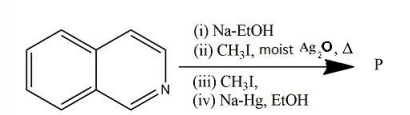
The final product (P) is
Consider the following statements with respect to citral
(A). Geranial and Neral are geometrical isomers of citral.
(B). It forms geranic acid on heating with potassium hydrogen sulphate.
(C). It gives 6-methylhept-5-en-2-one on treating with potassium carbonate.
(D). On oxidation with silver oxide it yields Laevulic acid.
Choose the correct answer from the options given below:Which correct sequence of reactions are applied to achieve the following transformation?

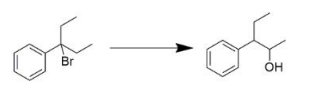
Above conversion is carried out using

The final product (D) in the above conversion is


