
The final product (P) is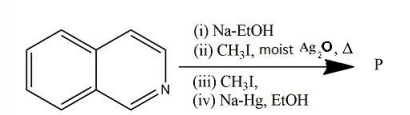
The given reaction sequence involves the conversion of quinoline into a final product through a series of steps. Let's analyze each step in the reaction sequence:
- Step (i): Na-EtOH
- The use of sodium ethoxide (Na-EtOH) implies a possible deprotonation or generation of an organo-metallic intermediate. This can result in the formation of an ethoxy group addition or aid in further nucleophilic substitutions.
- Step (ii): CH3I, moist Ag2O, Δ
- The presence of methyl iodide (CH3I) and silver oxide (Ag2O) suggests a methylation reaction. CH3I acts as a methylating agent, likely leading to the substitution of a hydrogen or another group by a methyl group.
- The heat (Δ) indicates conditions favorable for reaction or rearrangement.
- Step (iii): CH3I
- Further methylation is achieved using CH3I. This suggests that another site within the molecule is available for methyl group substitution.
- Step (iv): Na-Hg, EtOH
- The use of sodium amalgam (Na-Hg) and ethanol (EtOH) suggests a reductive step that might involve the reduction of double bonds or other oxidized functionalities.
Based on the given steps, the quinoline ring is first modified by adding ethoxy, methyl groups, and undergoes reduction. The final product (P) corresponds to one of the options that fits these transformations.
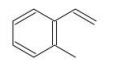
After analyzing the transformations, the correct structure that matches the conversion steps is determined to be:
Therefore, the correct answer is the structure depicted above.
Important Questions from Chemistry (CUET PG) Mixed
- Arrange the following coal types in the increasing order of their heat content (KJ/kg)
(A). Peat
(B). Lignite
(C). Anthracite
(D). Bituminous
(E) Sub-bituminous
Choose the correct answer from the options given below: - In which of the following layers of atmosphere, does the temperature decrease with the increase in height from the earth's surafce?
(A). Troposphere
(B). Mesosphere
(C). Thermosphere
(D). Stratosphere
Choose the correct answer from the options given below: Choose the correct statement from the following:
(A). Water has highest density at 4°C
(B). Freezing point of water is 0°C
(C) An Ice cube does not completely dip in water, rather floats on water in a glass.
(D). Addition of common salt reduces freezing point of water.
Choose the correct answer from the options given below:- The number of atoms per unit cell of SCC are:
Which of the following statements are correct:
A. In SC structure $a =2r$
B. In SC structure $a =r/2$
C. In BCC structure $a = 4r/\sqrt{3}$.
D. In FCC structure $a = 2\sqrt{2} r$
Where $a$ is a lattice parameter and $r$ is the atomic radius.


