
The major product (P) in the following transformation is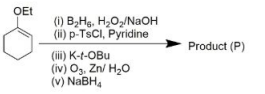
To determine the major product (P) of the given transformation, let's analyze each step of the reaction:
- Hydroboration-Oxidation: The first step involves hydroboration using B_2H_6 followed by oxidation with H_2O_2/NaOH. This converts the alkene to an alcohol by adding an -OH group to the less substituted carbon. For the given structure, this will create a primary alcohol.
- Tosylation: The alcohol is then treated with p-TsCl and pyridine. This converts the alcohol into a tosylate, a better leaving group.
- Nucleophilic Attack: With a good leaving group in place, K^{+}-tBuO acts as a nucleophile, resulting in substitution or elimination. Given the reaction conditions, it likely results in deprotonation leading to the elimination product or rearrangement.
- Ozonolysis: Using O_3, Zn/H_2O, any double bond or unsaturation present will be cleaved to form carbonyl compounds. In this context, it won't cleave or modify the main chain directly if not applied to an unsaturated site.
- Reduction: Finally, NaBH_4 reduces carbonyl groups to alcohols.
Considering the steps and reagents, particularly the presence of the ether group initially and converting into an alcohol, we deduce the transformation results in adding an additional alcohol group and retaining the ether group after transformation. The key alteration from the given structure forms a diol with the existing ether.
Thus, the major product formed will be 2-Ethoxyhexane-1,6-diol, as reduction creates a diol structure, which leaves the OEt intact and adds -OH groups at terminal positions.
Important Questions from Chemistry (CUET PG) Mixed
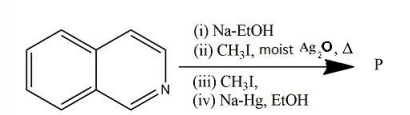
The final product (P) is
Consider the following statements with respect to citral
(A). Geranial and Neral are geometrical isomers of citral.
(B). It forms geranic acid on heating with potassium hydrogen sulphate.
(C). It gives 6-methylhept-5-en-2-one on treating with potassium carbonate.
(D). On oxidation with silver oxide it yields Laevulic acid.
Choose the correct answer from the options given below:Which correct sequence of reactions are applied to achieve the following transformation?

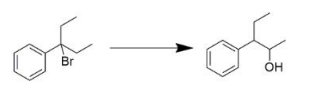
Above conversion is carried out using

The final product (D) in the above conversion is


