The major product formed in the following reaction sequence is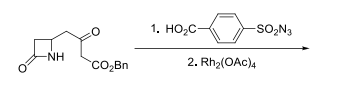
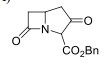
To determine the major product of the given reaction sequence, we need to analyze each step of the reaction:
Formation of a Nitrene Intermediate: The reaction involves the use of \(HO_2C\)−\(C_6H_4\)−\(SO_2N_3\), which is a sulfonyl azide. Under the given conditions, this compound decomposes to form a nitrene intermediate. This is a common transformation in organic chemistry, where azides convert into nitrenes by losing nitrogen gas (\(N_2\)).
Insertion Reaction: The generated nitrene intermediate is highly reactive and can insert into C-H bonds. In this case, Rhodium acetate \(Rh_2(OAc)_4\) is used as a catalyst to facilitate this process. The nitrene inserts into a C-H bond adjacent to the amide group, resulting in the formation of a new C-N bond. This leads to the formation of a lactam ring.
Selectivity and Product Formation: The reaction is selective for certain C-H bonds due to the directing effect of the existing functional groups, such as the amide. The structure of the major product is determined by the regioselectivity of the insertion, favoring the formation of a particular lactam structure.
The correct major product based on these steps is 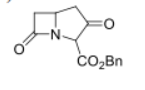
Important Questions from Organic Transformations and Reagents
The presence of unsaturation in an organic compound can be detected by
Which of the following boron compounds is used as a reducing agent in organic synthesis?
In elimination reaction of sec-Butyl trimethylammonium hydroxide, major product formed would be ________.
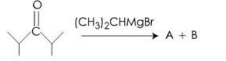
Find out the suitable products in the following Grignard reaction:
What will be the product in the following reaction ?