
Enzymatic Reaction Velocity Calculation
This problem involves calculating the specific reaction velocity ($V$) for an enzymatic reaction using the Michaelis-Menten kinetic model. We are given the maximum reaction velocity ($V_{max}$), the Michaelis constant ($K_m$), and the substrate concentration ($[S]$).
Michaelis-Menten Equation
The core equation relating these parameters is the Michaelis-Menten equation:
$ V = \frac{V_{max}[S]}{K_m + [S]} $
Where:
- $V$ is the reaction velocity at a given substrate concentration.
- $V_{max}$ is the maximum velocity when the enzyme is saturated with substrate.
- $K_m$ is the substrate concentration at which the reaction velocity is half of $V_{max}$.
- $[S]$ is the substrate concentration.
Applying the Given Values
We are provided with the following values:
- $V_{max} = 160 \, \mu mol/l.min$
- $K_m = 60 \, \mu mol/l$
- $[S] = 40 \, \mu mol/l$
Substitute these values into the Michaelis-Menten equation:
$ V = \frac{(160 \, \mu mol/l.min) \times (40 \, \mu mol/l)}{(60 \, \mu mol/l) + (40 \, \mu mol/l)} $
Calculation Steps
- Calculate the numerator: $V_{max} \times [S]$ $ 160 \times 40 = 6400 $
- Calculate the denominator: $K_m + [S]$ $ 60 + 40 = 100 $
- Divide the numerator by the denominator to find $V$: $ V = \frac{6400}{100} $ $ V = 64 \, \mu mol/l.min $
Result
The estimated velocity of the reaction at a substrate concentration of $40 \, \mu mol/l$ is $64 \, \mu mol/l.min$. This result aligns with the provided answer range.
Important Questions from Enzyme Kinetics Michaelis Menten K_m V_{max}
- An enzyme following Michaelis-Menten kinetics, catalyses a reaction with an initial velocity ($V_0$) of $2\ \mu\text{M s}^{-1}$ at the substrate concentration of $10\ \mu\text{M}$. If the turnover number ($k_{\text{cat}}$) of the enzyme for the given substrate is $500\ \text{s}^{-1}$ and the enzyme concentration in the reaction is $0.01\ \mu\text{M}$, then the value of the Michaelis-Menten constant ($K_m$) would be__________ $\times\ 10^{-6}\ \text{M}$ (in integer).
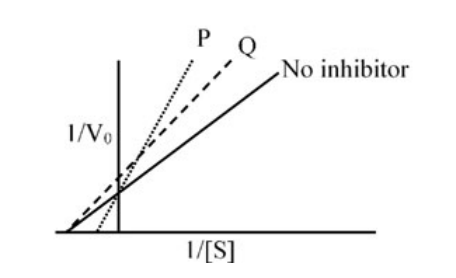
The graph below shows the activity of enzyme pepsin in the presence of inhibitors aliphatic alcohols (P) or N-acetyl-1-phenylalanine (Q). Which ONE of the following represents the nature of inhibition by P and Q, respectively?
The following plot represents the Lineweaver-Burk equation of an enzymatic reaction both in the presence and the absence of inhibitor. Here, V is the velocity of reaction and S is the substrate concentration.
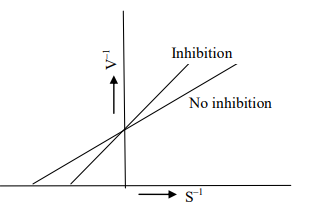
The nature of inhibition shown in the plot is
- For an enzyme catalyzed reaction, the plot that correctly represents the relationship between the rate and temperature is
- In an enzyme catalyzed reaction, the initial reaction velocity is only one fourth of its maximum velocity. If the substrate concentration is $3.0 \times 10^{-3}$ mM, the value of $K_m$ in micro molar ($\mu$M) will be ....


