
Michaelis-Menten Calculation: Finding Km
This problem requires calculating the Michaelis-Menten constant ($K_m$) using the given kinetic parameters for an enzyme reaction.
Identify Given Parameters
- Initial Velocity ($V_0$): $2\ \mu\text{M s}^{-1}$
- Substrate Concentration ($[S]$): $10\ \mu\text{M}$
- Turnover Number ($k_{\text{cat}}$): $500\ \text{s}^{-1}$
- Enzyme Concentration ($[E]_0$): $0.01\ \mu\text{M}$
Calculate Maximum Velocity (Vmax)
The maximum velocity ($V_{max}$) is related to the turnover number ($k_{\text{cat}}$) and the total enzyme concentration ($[E]_0$) by the formula:
$V_{max} = k_{\text{cat}} \times [E]_0$
Substitute the given values:
$V_{max} = 500\ \text{s}^{-1} \times 0.01\ \mu\text{M}$
$V_{max} = 5\ \mu\text{M s}^{-1}$
Calculate Michaelis-Menten Constant (Km)
The Michaelis-Menten equation relates initial velocity ($V_0$), maximum velocity ($V_{max}$), substrate concentration ($[S]$), and the Michaelis-Menten constant ($K_m$):
$V_0 = \frac{V_{max} [S]}{K_m + [S]}$
Rearrange the equation to solve for $K_m$:
$K_m + [S] = \frac{V_{max} [S]}{V_0}$
$K_m = \left( \frac{V_{max} [S]}{V_0} \right) - [S]$
Substitute the known values:
$K_m = \left( \frac{(5\ \mu\text{M s}^{-1}) \times (10\ \mu\text{M})}{2\ \mu\text{M s}^{-1}} \right) - 10\ \mu\text{M}$
$K_m = \left( \frac{50}{2} \right)\ \mu\text{M} - 10\ \mu\text{M}$
$K_m = 25\ \mu\text{M} - 10\ \mu\text{M}$
$K_m = 15\ \mu\text{M}$
Final Answer Format
The question asks for the value of $K_m$ in the format $__________ \times 10^{-6}\ \text{M}$ (in integer). Since $1\ \mu\text{M} = 1 \times 10^{-6}\ \text{M}$:
$K_m = 15 \times 10^{-6}\ \text{M}$
The integer value required is 15.
Important Questions from Enzyme Kinetics Michaelis Menten K_m V_{max}
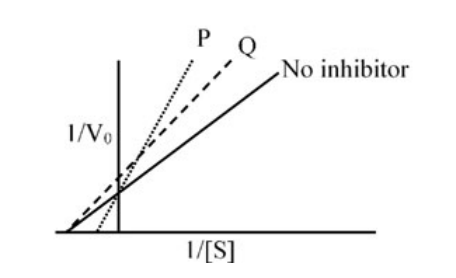
The graph below shows the activity of enzyme pepsin in the presence of inhibitors aliphatic alcohols (P) or N-acetyl-1-phenylalanine (Q). Which ONE of the following represents the nature of inhibition by P and Q, respectively?
The following plot represents the Lineweaver-Burk equation of an enzymatic reaction both in the presence and the absence of inhibitor. Here, V is the velocity of reaction and S is the substrate concentration.
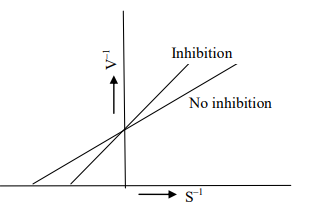
The nature of inhibition shown in the plot is
- For an enzyme catalyzed reaction, the plot that correctly represents the relationship between the rate and temperature is
- In an enzyme catalyzed reaction, the initial reaction velocity is only one fourth of its maximum velocity. If the substrate concentration is $3.0 \times 10^{-3}$ mM, the value of $K_m$ in micro molar ($\mu$M) will be ....
- The Lineweaver-Burk plot of an enzymatic reaction shows $V_{max}$ of $160 \, \mu mol/l.min$ and $k_m$ of $60 \, \mu mol/l$. For a substrate concentration of $40 \, \mu mol/l$, the velocity of the reaction is estimated to be __________ $\mu mol/l.min$.


