
The following plot represents the Lineweaver-Burk equation of an enzymatic reaction both in the presence and the absence of inhibitor. Here, V is the velocity of reaction and S is the substrate concentration. The nature of inhibition shown in the plot is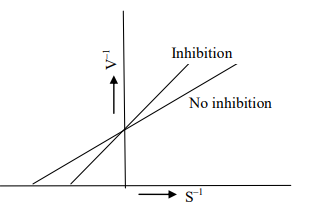
To determine the nature of inhibition depicted in the Lineweaver-Burk plot provided, we need to understand how different types of inhibition manifest in such plots.
The Lineweaver-Burk plot is a double reciprocal plot of the Michaelis-Menten equation. It is represented as follows:
\(\frac{1}{V} = \frac{K_m}{V_{max}} \cdot \frac{1}{[S]} + \frac{1}{V_{max}}\)
The slope of the Lineweaver-Burk plot is \(\frac{K_m}{V_{max}}\), the y-intercept is \(\frac{1}{V_{max}}\), and the x-intercept is \(-\frac{1}{K_m}\).
Competitive Inhibition: In this type of inhibition, the inhibitor competes with the substrate for the active site of the enzyme. In the presence of a competitive inhibitor:
- The slope of the Lineweaver-Burk plot increases because \(K_m\) appears to increase (since the substrate is less effective at lower concentrations of inhibitor), while \(V_{max}\) remains unchanged.
- The x-intercept (which reflects \(-\frac{1}{K_m}\)) moves closer to zero.
- The y-intercept (which reflects \(\frac{1}{V_{max}}\)) remains the same.
Based on the plot provided:
- We can observe that in the presence of an inhibitor, the slope of the plot increases while the y-intercept remains the same. This indicates that \(V_{max}\) does not change, which aligns with competitive inhibition.
Conclusion: The nature of inhibition shown in the plot is competitive as it matches the characteristics described above.
Important Questions from Enzyme Kinetics Michaelis Menten K_m V_{max}
- An enzyme following Michaelis-Menten kinetics, catalyses a reaction with an initial velocity ($V_0$) of $2\ \mu\text{M s}^{-1}$ at the substrate concentration of $10\ \mu\text{M}$. If the turnover number ($k_{\text{cat}}$) of the enzyme for the given substrate is $500\ \text{s}^{-1}$ and the enzyme concentration in the reaction is $0.01\ \mu\text{M}$, then the value of the Michaelis-Menten constant ($K_m$) would be__________ $\times\ 10^{-6}\ \text{M}$ (in integer).
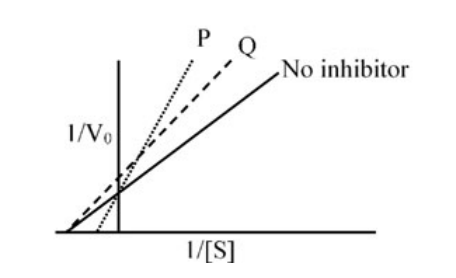
The graph below shows the activity of enzyme pepsin in the presence of inhibitors aliphatic alcohols (P) or N-acetyl-1-phenylalanine (Q). Which ONE of the following represents the nature of inhibition by P and Q, respectively?
- For an enzyme catalyzed reaction, the plot that correctly represents the relationship between the rate and temperature is
- In an enzyme catalyzed reaction, the initial reaction velocity is only one fourth of its maximum velocity. If the substrate concentration is $3.0 \times 10^{-3}$ mM, the value of $K_m$ in micro molar ($\mu$M) will be ....
- The Lineweaver-Burk plot of an enzymatic reaction shows $V_{max}$ of $160 \, \mu mol/l.min$ and $k_m$ of $60 \, \mu mol/l$. For a substrate concentration of $40 \, \mu mol/l$, the velocity of the reaction is estimated to be __________ $\mu mol/l.min$.


