
The kinetic data for a single substrate enzyme is shown below. The concentration of inhibitor [I] used in the reaction was equal to the $K_i$ of the inhibitor. The $K_m$ value of an uninhibited reaction is $2 \ × \ 10^{-5} \ M$. In the presence of the inhibitor, the observed $K_m$ value is _____________ $× \ 10^{-5} \ M$.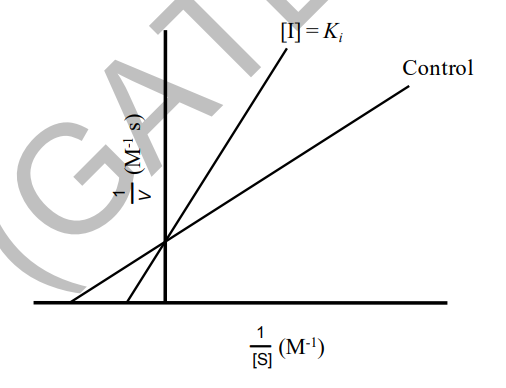
To find the observed Km value in the presence of an inhibitor where [I] = Ki, we analyze the Lineweaver-Burk plot provided. The equation for a competitive inhibitor is:
Competitive Inhibition Lineweaver-Burk Equation:
\(\frac{1}{V_0} = \frac{K_m(1 + \frac{[I]}{K_i})}{V_{max}[S]} + \frac{1}{V_{max}}\)
Since [I] = Ki, the factor \(1 + \frac{[I]}{K_i}\) becomes 2.
- Given: Uninhibited \(K_m = 2 \times 10^{-5} \, M\)
- Observed in the presence of inhibitor:
Km(obs) = \(K_m \times (1 + \frac{[I]}{K_i}) = 2 \times 10^{-5} \, M \times 2 = 4 \times 10^{-5} \, M\)
Thus, the observed Km value is 4 × 10⁻⁵ M.
Validation: The calculated value is 4, fitting perfectly within the specified range (4, 4).
Important Questions from Enzyme Kinetics Competitive Inhibition
- The CORRECT statement(s) about a competitive inhibitor of an enzyme is/are
- For a simple enzyme that follows Michaelis-Menten kinetics, kinetic data was collected in the absence (dotted line, -I), or presence (solid line, +I) of an uncompetitive inhibitor (I). Which one of the following Eadie-Hofstee plots best describes the expected result?
($v_0$ = initial velocity, $[S]$ = free substrate concentration) - Researchers measure the activity of an enzyme in the presence of an inhibitor. They observe that
- $V_{\text{max}}$ of the enzyme remains unchanged at saturating substrate concentration
- $K_m$ increases compared to uninhibited enzyme
The kinetics of an enzyme in the presence (+I) or absence (-I) of a reversible inhibitor is described in the following graph.
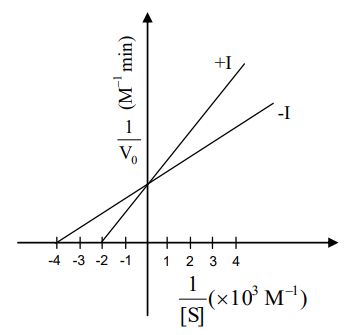
If concentration of the reversible inhibitor in +I experiment was equal to $3.0 \times 10^{-3}$ M, then the dissociation constant for the enzyme-inhibitor complex is
- In an in vitro dehydrogenation reaction of succinate catalyzed by succinate dehydrogenase, malonate is added. Which one of the following curves represents the effect of malonate on the catalysis of succinate dehydrogenase?


