
Which type of inhibition is most consistent with these observations?
Enzyme Inhibition Analysis
Enzyme kinetics involves studying reaction rates. Key parameters include $V_{\text{max}}$, the maximum reaction velocity, and $K_m$, the substrate concentration required to reach half of $V_{\text{max}}$. An inhibitor affects these parameters based on its mechanism.
Effects of Different Inhibitor Types
The question states that $V_{\text{max}}$ is unchanged, while $K_m$ increases. Let's examine common inhibition types:
- Competitive Inhibition: The inhibitor molecule competes directly with the substrate for binding to the enzyme's active site. It increases the apparent $K_m$ because more substrate is needed to overcome the inhibitor. However, $V_{\text{max}}$ remains unchanged as the substrate can eventually displace the inhibitor at saturating concentrations.
- Non-competitive Inhibition: The inhibitor binds to a site distinct from the active site, altering the enzyme's structure and reducing its efficiency. This typically decreases $V_{\text{max}}$ but does not affect $K_m$.
- Irreversible Inhibition: This inhibitor permanently inactivates the enzyme, usually by forming a covalent bond. This reduces the concentration of active enzyme, effectively lowering $V_{\text{max}}$.
- Substrate Inhibition: Occurs only at very high substrate concentrations, where the substrate itself can bind in a manner that hinders catalysis. This leads to a decrease in $V_{\text{max}}$ at supra-optimal substrate levels.
Conclusion from Observations
The observed kinetic data ($V_{\text{max}}$ unchanged, $K_m$ increased) directly matches the characteristics of competitive inhibition. The inhibitor raises the substrate concentration needed for half-maximal velocity ($K_m$) but does not limit the maximum possible rate ($V_{\text{max}}$).
Important Questions from Enzyme Kinetics Competitive Inhibition
- The CORRECT statement(s) about a competitive inhibitor of an enzyme is/are
- For a simple enzyme that follows Michaelis-Menten kinetics, kinetic data was collected in the absence (dotted line, -I), or presence (solid line, +I) of an uncompetitive inhibitor (I). Which one of the following Eadie-Hofstee plots best describes the expected result?
($v_0$ = initial velocity, $[S]$ = free substrate concentration) The kinetics of an enzyme in the presence (+I) or absence (-I) of a reversible inhibitor is described in the following graph.
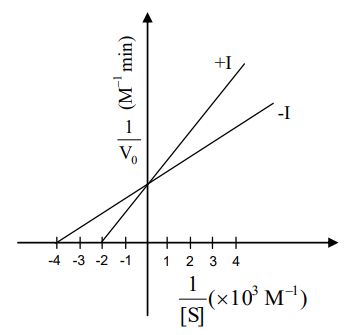
If concentration of the reversible inhibitor in +I experiment was equal to $3.0 \times 10^{-3}$ M, then the dissociation constant for the enzyme-inhibitor complex is
- In an in vitro dehydrogenation reaction of succinate catalyzed by succinate dehydrogenase, malonate is added. Which one of the following curves represents the effect of malonate on the catalysis of succinate dehydrogenase?
- Aromatase inhibitors are often prescribed for post-menopausal women to treat estrogen receptor positive breast cancer patients, because these class of drugs


