
Competitive Inhibitor: Binding Site Characteristics
A competitive inhibitor operates by binding to the enzyme's substrate-binding site, which is also known as the active site. This binding directly competes with the natural substrate.
-
Statement 1: The competitive inhibitor binds to the substrate-binding site of the enzyme
This statement is correct. It accurately describes the fundamental mechanism of competitive inhibition, where the inhibitor occupies the active site.
-
Statement 2: The competitive inhibitor binds to the substrate
This statement is incorrect. Competitive inhibitors interact with the enzyme itself, specifically at the active site, not with the substrate molecule.
Competitive Inhibitor Effectiveness & Substrate Concentration
The effectiveness of a competitive inhibitor is inversely related to the substrate concentration. By adding more substrate, the enzyme is more likely to bind the substrate than the inhibitor.
-
Statement 3: The competitive inhibitor is less effective at higher substrate concentration
This statement is correct. As the substrate concentration increases, it successfully competes with the inhibitor, reducing the inhibitor's overall effect on enzyme activity.
-
Statement 4: The competitive inhibitor is more effective at higher substrate concentration
This statement is incorrect. Higher substrate concentrations diminish the inhibitor's effectiveness, making it less potent, not more.
Conclusion: The correct statements detailing the behavior of a competitive inhibitor are that it binds to the substrate-binding site and is less effective at higher substrate concentrations.
Important Questions from Enzyme Kinetics Competitive Inhibition
- For a simple enzyme that follows Michaelis-Menten kinetics, kinetic data was collected in the absence (dotted line, -I), or presence (solid line, +I) of an uncompetitive inhibitor (I). Which one of the following Eadie-Hofstee plots best describes the expected result?
($v_0$ = initial velocity, $[S]$ = free substrate concentration) - Researchers measure the activity of an enzyme in the presence of an inhibitor. They observe that
- $V_{\text{max}}$ of the enzyme remains unchanged at saturating substrate concentration
- $K_m$ increases compared to uninhibited enzyme
The kinetics of an enzyme in the presence (+I) or absence (-I) of a reversible inhibitor is described in the following graph.
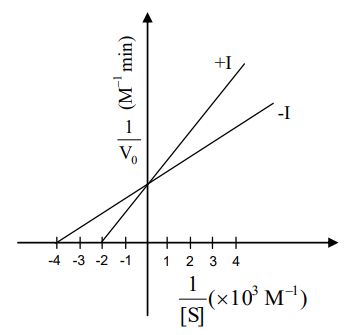
If concentration of the reversible inhibitor in +I experiment was equal to $3.0 \times 10^{-3}$ M, then the dissociation constant for the enzyme-inhibitor complex is
- In an in vitro dehydrogenation reaction of succinate catalyzed by succinate dehydrogenase, malonate is added. Which one of the following curves represents the effect of malonate on the catalysis of succinate dehydrogenase?
- Aromatase inhibitors are often prescribed for post-menopausal women to treat estrogen receptor positive breast cancer patients, because these class of drugs


