
Aromatase Inhibitors Mechanism in Breast Cancer
Aromatase inhibitors are crucial medications used in treating estrogen receptor-positive (ER+) breast cancer, particularly in post-menopausal women.
Understanding Aromatase Activity
In post-menopausal women, the primary source of estrogen is the peripheral conversion of androgens (like androstenedione) into estrogens (like estrone and estradiol) by the enzyme aromatase. This process is called estrogen biosynthesis.
Action of Aromatase Inhibitors
Aromatase inhibitors work by blocking the action of the aromatase enzyme. This significantly reduces the production of estrogens, including estradiol ($E_2$), in the body.
- Key Function: Lowering estrogen levels is vital because ER+ breast cancer cells use estrogen to grow and multiply.
- Therapeutic Effect: By reducing the available estrogen, aromatase inhibitors deprive the cancer cells of a critical growth stimulus, thereby helping to control or slow the cancer's progression.
Evaluating the Options
- Option 1 (Prostaglandins): Incorrect. Aromatase inhibitors do not primarily target prostaglandin biosynthesis.
- Option 2 (Estradiol Biosynthesis): Correct. This directly describes the mechanism by which aromatase inhibitors reduce estrogen levels.
- Option 3 (Testosterone to DHT): Incorrect. The conversion of testosterone to dihydrotestosterone is mediated by 5-alpha-reductase, not aromatase.
- Option 4 (Non-toxic): Incorrect. While effective, aromatase inhibitors can have side effects and are not universally non-toxic. This option describes safety, not the mechanism of action.
Therefore, the reason aromatase inhibitors are prescribed is their ability to reduce the level of estradiol biosynthesis.
Important Questions from Enzyme Kinetics Competitive Inhibition
- The CORRECT statement(s) about a competitive inhibitor of an enzyme is/are
- For a simple enzyme that follows Michaelis-Menten kinetics, kinetic data was collected in the absence (dotted line, -I), or presence (solid line, +I) of an uncompetitive inhibitor (I). Which one of the following Eadie-Hofstee plots best describes the expected result?
($v_0$ = initial velocity, $[S]$ = free substrate concentration) - Researchers measure the activity of an enzyme in the presence of an inhibitor. They observe that
- $V_{\text{max}}$ of the enzyme remains unchanged at saturating substrate concentration
- $K_m$ increases compared to uninhibited enzyme
The kinetics of an enzyme in the presence (+I) or absence (-I) of a reversible inhibitor is described in the following graph.
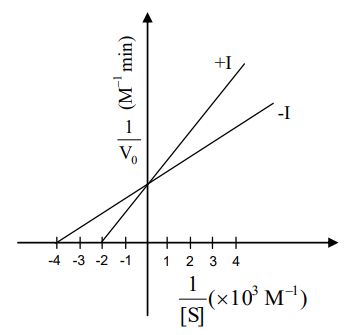
If concentration of the reversible inhibitor in +I experiment was equal to $3.0 \times 10^{-3}$ M, then the dissociation constant for the enzyme-inhibitor complex is
- In an in vitro dehydrogenation reaction of succinate catalyzed by succinate dehydrogenase, malonate is added. Which one of the following curves represents the effect of malonate on the catalysis of succinate dehydrogenase?


