
Question
The intermediates involved in the following reaction are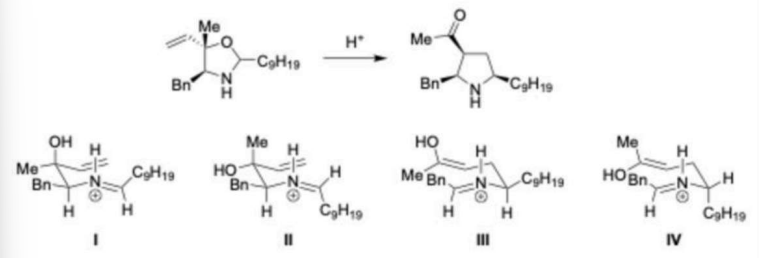
The correct answer is
I and III
The given reaction involves the cyclization of an enyne under acidic conditions. Let's analyze the intermediates involved in this transformation.
- Upon protonation of the alkyne, a resonance-stabilized carbocation intermediate is formed. This is characterized by the structure commonly seen with alcohol groups being converted into carbocations.
- The first intermediate formed is consistent with structure I, where the hydroxyl group is protonated and forms a significant resonance-stabilized carbocation structure.
- The next step involves further transformation of this carbocation intermediate. Intramolecular attack by the nitrogen atom forms another stable intermediate, which is depicted by structure III.
Thus, the intermediates involved in this reaction are indeed I and III, making the correct answer:
- I and III
Let's rule out the other options:
- II and III: Intermediate II does not form due to the absence of the protonated configuration that leads to this structure.
- I and IV: Intermediate IV represents a structure that does not align with the reaction mechanism under the given conditions.
- II and IV: Both intermediates do not fit into the pathway of this transformation.
Was this answer helpful?
Important Questions from Organic Reaction Mechanisms
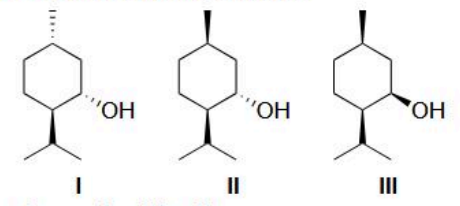
The correct order for the relative rate of esterification of I, II, and III with p-nitrobenzoyl chloride is
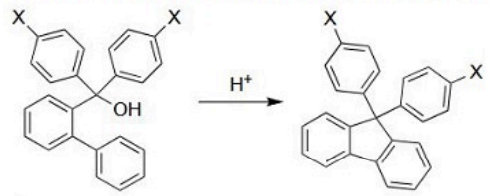
The Hammett plot for the following transformation is :
The correct sequence of processes involved in the following transformation is :
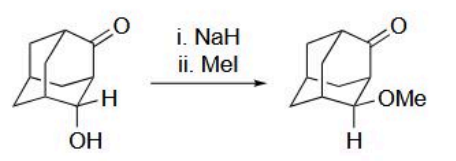
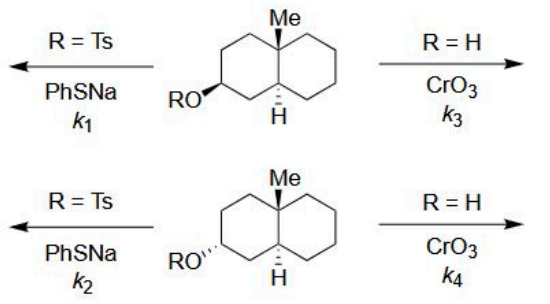
The relative order of rate constants in the following transformations are
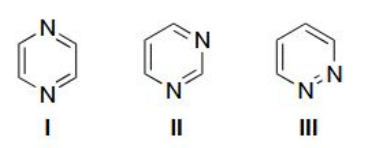
The correct order of basicity for the following compounds is
Need Expert Advice?


