
To determine the number of copies of a specific allele on the Y chromosome within a population, follow these steps:
Identify Relevant Population Subset
Since the allele is located on the non-recombining region of the Y chromosome, it is only present in males. The Y chromosome is passed directly from father to son.
Calculate Number of Males
Given the total population size is N and the sex ratio is 1:1, the proportion of males in the population is approximately 1/2. Therefore, the number of males is:
$ \text{Number of Males} = \frac{N}{2} $
Determine Total Y Chromosome Alleles
Each male individual carries one Y chromosome. Thus, the total number of Y chromosomes (and consequently, the total number of alleles at a given Y-linked locus) in the population is equal to the number of males.
$ \text{Total Y Alleles} = \text{Number of Males} = \frac{N}{2} $
Calculate Allele Copies
The allele frequency represents the proportion of a specific allele among all alleles at that locus. To find the number of copies of this specific allele, multiply its frequency by the total number of Y-linked alleles in the population.
$ \text{Number of Allele Copies} = (\text{Allele Frequency}) \times (\text{Total Y Alleles}) $
Substituting the given values:
$ \text{Number of Allele Copies} = 0.3 \times \frac{N}{2} = \frac{0.3 N}{2} $
Therefore, the number of copies of the allele in the population is $ \frac{0.3 N}{2} $.
Important Questions from Allele frequencies
- In a population, the frequency of an allele changes with time as given in the table:Which one of the following describes how allele frequency changes with year?
Year (x) 0 10 20 30 40 Allele frequency (y) 0.1 0.2 0.3 0.4 0.5 The graph shows the relationship between a variable on the x-axis and genetic diversity on the y-axis. Each point represents a species and the trend line describes the relationship across species.
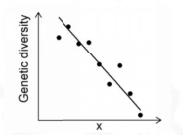
Select the most appropriate variable for the x-axis.- Consider a diploid population at Hardy-Weinberg equilibrium. For a locus with two alleles, the frequency of the $A_1A_1$ genotype is 0.01. The frequency of heterozygotes $A_1A_2$ is ________ (answer up to 2 decimal places).
- There are N individuals in a haploid population. At a given locus, there are 2 alleles, AL1 and AL2. The number of copies of allele AL1 is Z1, and the number of copies of allele AL2 is Z2 in the population. What is the frequency of allele AL2?


