
Finding Bird Beak Size Median
The problem asks for the median beak size given a frequency distribution with specific properties: it is symmetric but not normally distributed. We are provided with the mean value, standard deviation, and kurtosis.
Symmetry and Central Tendency
A key property of any symmetric distribution is that its measures of central tendency coincide. This means the mean, median, and mode are equal.
- Mean: The average value.
- Median: The middle value when data is ordered.
- Mode: The most frequent value.
In a symmetric distribution, Median = Mean.
Applying Symmetry to Beak Sizes
The question explicitly states the frequency distribution of beak sizes is symmetric.
- Given Mean beak size ($\mu$) = 6 mm.
Because the distribution is symmetric, the median must be equal to the mean.
- Therefore, Median = 6 mm.
Irrelevant Information
While the standard deviation ($\sigma$ = 25 mm) and kurtosis (10) provide information about the spread and shape (peakedness/tailedness) of the distribution, they do not alter the relationship between the mean and median in a symmetric distribution. The fact that it's not normally distributed is also secondary to the property of symmetry.
Conclusion
Based on the symmetry of the distribution, the median beak size is equal to the given mean beak size.
- Median = 6 mm.
This value falls within the range suggested by the correct answer (5.9 to 6.1 mm).
Important Questions from Mean Median Mode
- The median of the following set of numbers: 154, 130, 144, 137, 156, 146, 138, 149, 160, 138 is:
- Let $X$ be a continuous random variable whose cumulative distribution function (CDF)
$F_X(x) = \begin{cases} 0 & x < t \\ \frac{x-t}{4-t} & t \le x \le 4 \\ 1 & x \ge 4 \end{cases}$
If the median of $X$ is $3$, then what is the value of $t$? - The elements of the dataset $\{-5,1, a, 5, b\}$ are in ascending order. If both mean and median of the dataset are equal to 3, what is the value of $b$?
- The sample average of 50 data points is 40. The updated sample average after including a new data point taking the value of 142 is ________.
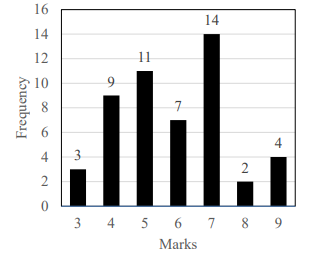
The above frequency chart shows the frequency distribution of marks obtained by a set of students in an exam. From the data presented above, which one of the following is CORRECT?


