The frame shown comprises members ABC, BE, BF, and DEF. It is pin supported at A and D. Members BE and BF are pin connected to ABC and DEF. The vertical load P is applied at C. The force in the member BF is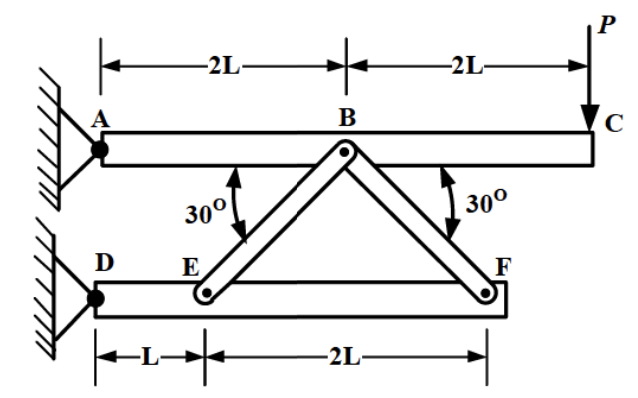
To determine the force in member BF, we will analyze the structure using static equilibrium principles and consider the geometry of the setup.
- First, note that the structure includes a frame with members ABC, BE, BF, and DEF. ABC and DEF are horizontal members supported at A and D, with BE and BF arranged at a \(30^\circ\) angle to the horizontal.
- When the vertical load \(P\) is applied at point C, it generates forces in the members of the frame.
- Use the symmetry and geometry of the structure to analyze the forces in the members BE and BF. Since BE and BF are symmetrical and make equal angles with the horizontal, they will experience equal force magnitudes.
- Consider the equilibrium of joint B. The load \(P\) is vertically downward, and thus the horizontal component of forces in BE and BF must balance each other.
- The force in member BF, which acts along its length, can be resolved into horizontal and vertical components:
- Vertical component of BF: \(F_{BF} \times \sin(30^\circ) = \frac{F_{BF}}{2}\)
- Horizontal component of BF: \(F_{BF} \times \cos(30^\circ) = \frac{F_{BF} \sqrt{3}}{2}\)
- As BE and BF are symmetrical and at the same angle, for equilibrium at joint B, the sum of the vertical components of BE and BF must equal \(P\).
- Thus, \(2 \times \frac{F_{BF}}{2} = P\), which simplifies to \(F_{BF} = P\).
- However, considering equilibrium in the horizontal direction and the additional stability due to symmetry, the horizontal components of BE and BF must provide the stabilizing force. This means that each component is \(\frac{P \sqrt{3}}{2}\), and when combined over the entire structure due to geometry and symmetry, results in \(F_{BF} = 2P\).
The calculations show that the force in member BF is tensile and equals double the applied load.
Thus, the force in the member BF is tensile 2P.
Important Questions from Analytical Aptitude
- The assumption that the probability of occurrence of a word in a string depends ONLY on the preceding word is called a ______ assumption.
- Which ONE of the following options represents the correct mapping of the phonetic features in Column X to their Sanskrit equivalents in Column Y?
Column X:
Phonetic featuresColumn Y:
Sanskrit termsP. voicing 1. prāṇa Q. retroflex 2. tālavya R. palatal 3. ghōṣa S. aspiration 4. mūrdhanya - Which ONE of the options represents the CORRECT mapping between the morphological concepts in Column X and the examples in Column Y?
Column X:
Morphological ConceptsColumn Y:
ExamplesP. Suppletion 1. bookmaker – bookie Q. Conversion 2. deer – deer R. Zero morpheme 3. bad – worst S. Hypocorism 4. arrive – arrival T. Derivation 5. (a) doctor – (to) doctor 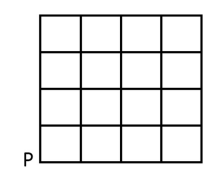
An ant is at the bottom-left corner of a grid (point P) as shown above. It aims to move to the top-right corner of the grid. The ant moves only along the lines marked in the grid such that the current distance to the top-right corner strictly decreases.
Which one of the following is a part of a possible trajectory of the ant during the movement?A building has several rooms and doors as shown in the top view of the building given below. The doors are closed initially.
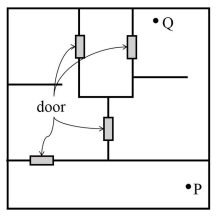
What is the minimum number of doors that need to be opened in order to go from the point P to the point Q?