
Markov Assumption Explained
The question describes a specific assumption used in probability and sequence analysis, particularly in Natural Language Processing (NLP).
Key Assumption
- The core idea is that the likelihood of a specific word appearing next in a sequence is determined *only* by the immediately preceding word.
- This is known as the Markov assumption or the Markov property.
Why Markov?
- A Markov chain models sequences where the probability of transitioning to the next state depends only on the current state.
- In this context, words are the "states," and the assumption means $P(word_n | word_{n-1}, word_{n-2}, ..., word_1) = P(word_n | word_{n-1})$.
- This simplifies the calculation of probabilities in language models significantly.
Other Options
- Gaussian relates to the normal distribution, not sequence dependencies.
- Chebyshev is associated with inequalities regarding probability distributions and variance.
- Turing is linked to computation theory and machines, not this specific probabilistic assumption.
Therefore, the assumption that the probability of occurrence of a word depends ONLY on the preceding word is the Markov assumption.
Important Questions from Analytical Aptitude
- Which ONE of the following options represents the correct mapping of the phonetic features in Column X to their Sanskrit equivalents in Column Y?
Column X:
Phonetic featuresColumn Y:
Sanskrit termsP. voicing 1. prāṇa Q. retroflex 2. tālavya R. palatal 3. ghōṣa S. aspiration 4. mūrdhanya - Which ONE of the options represents the CORRECT mapping between the morphological concepts in Column X and the examples in Column Y?
Column X:
Morphological ConceptsColumn Y:
ExamplesP. Suppletion 1. bookmaker – bookie Q. Conversion 2. deer – deer R. Zero morpheme 3. bad – worst S. Hypocorism 4. arrive – arrival T. Derivation 5. (a) doctor – (to) doctor 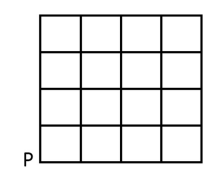
An ant is at the bottom-left corner of a grid (point P) as shown above. It aims to move to the top-right corner of the grid. The ant moves only along the lines marked in the grid such that the current distance to the top-right corner strictly decreases.
Which one of the following is a part of a possible trajectory of the ant during the movement?A building has several rooms and doors as shown in the top view of the building given below. The doors are closed initially.
What is the minimum number of doors that need to be opened in order to go from the point P to the point Q?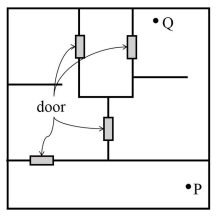
Three of the five students allocated to a hostel put in special requests to the warden. Given the floor plan of the vacant rooms, select the allocation plan that will accommodate all their requests.
Request by X: Due to pollen allergy, I want to avoid a wing next to the garden.
Request by Y: I want to live as far from the washrooms as possible, since I am very sensitive to smell.
Request by Z: I believe in Vaastu and so want to stay in the South-west wing.
The shaded rooms are already occupied. WR is washroom.


