Given that: French is easier than Dutch; Chinese is harder than Japanese; Dutch is easier than Japanese, and Spanish is easier than French.
Based on the above information, which girl is learning the most difficult pair of languages?
Language Difficulty Ranking
Establish the relative difficulty of the languages from the given statements:
- Spanish is easier than French: Spanish < French
- French is easier than Dutch: French < Dutch
- Dutch is easier than Japanese: Dutch < Japanese
- Chinese is harder than Japanese: Japanese < Chinese
Combining these inequalities gives the complete difficulty order from easiest to hardest:
Spanish < French < Dutch < Japanese < Chinese
Analyzing Language Pairs Difficulty
Evaluate the difficulty of the language pair each girl is learning:
- P learns French and Dutch. These languages fall in the lower-middle range of difficulty.
- Q learns Chinese and Japanese. These are the two hardest languages according to the ranking.
- R learns Spanish and French. These are the two easiest languages.
- S learns Dutch and Japanese. This pair includes a middle-difficulty language and a hard language.
Identifying Most Difficult Pair
Compare the pairs based on the established difficulty ranking:
- R's pair (Spanish, French) is the easiest.
- P's pair (French, Dutch) is of intermediate difficulty.
- S's pair (Dutch, Japanese) is harder than P's pair.
- Q's pair (Chinese, Japanese) comprises the two highest-ranked difficult languages.
Therefore, girl Q is learning the most difficult pair of languages.
Important Questions from Analytical Aptitude
- The assumption that the probability of occurrence of a word in a string depends ONLY on the preceding word is called a ______ assumption.
- Which ONE of the following options represents the correct mapping of the phonetic features in Column X to their Sanskrit equivalents in Column Y?
Column X:
Phonetic featuresColumn Y:
Sanskrit termsP. voicing 1. prāṇa Q. retroflex 2. tālavya R. palatal 3. ghōṣa S. aspiration 4. mūrdhanya - Which ONE of the options represents the CORRECT mapping between the morphological concepts in Column X and the examples in Column Y?
Column X:
Morphological ConceptsColumn Y:
ExamplesP. Suppletion 1. bookmaker – bookie Q. Conversion 2. deer – deer R. Zero morpheme 3. bad – worst S. Hypocorism 4. arrive – arrival T. Derivation 5. (a) doctor – (to) doctor 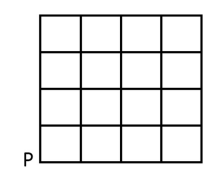
An ant is at the bottom-left corner of a grid (point P) as shown above. It aims to move to the top-right corner of the grid. The ant moves only along the lines marked in the grid such that the current distance to the top-right corner strictly decreases.
Which one of the following is a part of a possible trajectory of the ant during the movement?A building has several rooms and doors as shown in the top view of the building given below. The doors are closed initially.
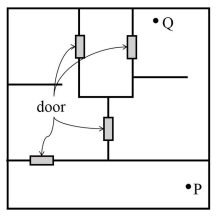
What is the minimum number of doors that need to be opened in order to go from the point P to the point Q?