
A building has several rooms and doors as shown in the top view of the building given below. The doors are closed initially.
What is the minimum number of doors that need to be opened in order to go from the point P to the point Q?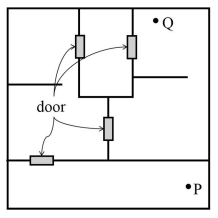
To find the minimum number of doors that need to be opened to go from point P to point Q, we analyze the top view of the building and the arrangement of doors.
Step-by-step Analysis:
- Identify the Path: Observe the layout and identify possible paths from P to Q. Each room and door configuration needs to be checked.
- Minimize Door Openings: The objective is to open the least number of doors.
- Consider Direct Path: Starting from point P, move towards the nearest door and assess if it leads directly closer to Q.
Upon examination of the diagram, the most efficient path involves:
- Open the first door leading directly from room adjacent to P.
- Proceed through the next room and open the second door to reach the pathway towards Q.
This path involves the following door openings:
- First door (from P to the next room).
- Second door (connecting the pathway to Q).
Consequently, the minimum number of doors to be opened is 2.
Conclusion: Thus, the correct answer is \(2\), as it represents the least number of door openings needed to move from point P to point Q.
Important Questions from Analytical Aptitude
- The assumption that the probability of occurrence of a word in a string depends ONLY on the preceding word is called a ______ assumption.
- Which ONE of the following options represents the correct mapping of the phonetic features in Column X to their Sanskrit equivalents in Column Y?
Column X:
Phonetic featuresColumn Y:
Sanskrit termsP. voicing 1. prāṇa Q. retroflex 2. tālavya R. palatal 3. ghōṣa S. aspiration 4. mūrdhanya - Which ONE of the options represents the CORRECT mapping between the morphological concepts in Column X and the examples in Column Y?
Column X:
Morphological ConceptsColumn Y:
ExamplesP. Suppletion 1. bookmaker – bookie Q. Conversion 2. deer – deer R. Zero morpheme 3. bad – worst S. Hypocorism 4. arrive – arrival T. Derivation 5. (a) doctor – (to) doctor 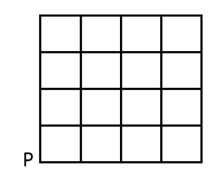
An ant is at the bottom-left corner of a grid (point P) as shown above. It aims to move to the top-right corner of the grid. The ant moves only along the lines marked in the grid such that the current distance to the top-right corner strictly decreases.
Which one of the following is a part of a possible trajectory of the ant during the movement?- A person was born on the fifth Monday of February in a particular year.
Which one of the following statements is correct based on the above information?


