
The following figures show the plot of reaction rate versus substrate concentration (mM) for an enzyme catalyzed reaction in the presence and absence of an inhibitor. Match the possible reaction types with the plots.
(P) Competitive inhibition
(R) Michaelis-Menten
(Q) Substrate inhibition
(S) Non-competitive inhibition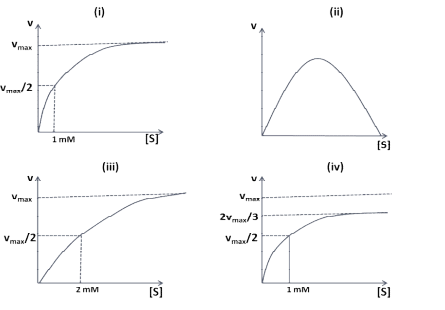
To solve this problem, we need to match the types of inhibition with the given plots. Each plot characterizes a rate of reaction ("v") versus substrate concentration ("[S]") for different enzymatic reaction situations.
Let's analyze each plot and match it with the correct reaction type:
- Plot (i): This plot shows a typical Michaelis-Menten curve where the reaction rate approaches a maximum velocity \( V_{\text{max}} \) as substrate concentration increases. Thus, this plot represents Michaelis-Menten kinetics.
- Plot (ii): In this graph, the reaction rate increases to a maximum and then decreases as substrate concentration increases. This represents substrate inhibition, where excessive substrate concentration actually inhibits enzyme activity.
- Plot (iii): This plot depicts a scenario where the presence of an inhibitor affects only the apparent affinity of the enzyme for the substrate, increasing the \( K_m \) value without affecting \( V_{\text{max}} \). This is characteristic of competitive inhibition.
- Plot (iv): This curve shows a reduction in the \( V_{\text{max}} \) without affecting the \( K_m \), which is characteristic of non-competitive inhibition. Here, the enzyme's maximum rate is lowered regardless of substrate concentration.
Based on this analysis, we can match the reaction types with their plots as follows:
- P – iii: Competitive inhibition
- Q – ii: Substrate inhibition
- R – i: Michaelis-Menten
- S – iv: Non-competitive inhibition
Thus, the correct answer is: P – iii, Q – ii, R – i, S – iv.
Important Questions from Enzyme Kinetics Competitive Inhibition
- The CORRECT statement(s) about a competitive inhibitor of an enzyme is/are
- For a simple enzyme that follows Michaelis-Menten kinetics, kinetic data was collected in the absence (dotted line, -I), or presence (solid line, +I) of an uncompetitive inhibitor (I). Which one of the following Eadie-Hofstee plots best describes the expected result?
($v_0$ = initial velocity, $[S]$ = free substrate concentration) - Researchers measure the activity of an enzyme in the presence of an inhibitor. They observe that
- $V_{\text{max}}$ of the enzyme remains unchanged at saturating substrate concentration
- $K_m$ increases compared to uninhibited enzyme
The kinetics of an enzyme in the presence (+I) or absence (-I) of a reversible inhibitor is described in the following graph.
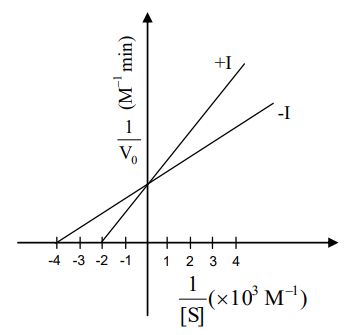
If concentration of the reversible inhibitor in +I experiment was equal to $3.0 \times 10^{-3}$ M, then the dissociation constant for the enzyme-inhibitor complex is
- In an in vitro dehydrogenation reaction of succinate catalyzed by succinate dehydrogenase, malonate is added. Which one of the following curves represents the effect of malonate on the catalysis of succinate dehydrogenase?


