
The figure in Panel I below is a grid of cells with four rows and four columns. The numbers on the top and on the left represent the number of cells that are to be shaded in that column and row, respectively. Which one of the options shown in Panel II below represents the grid shaded correctly?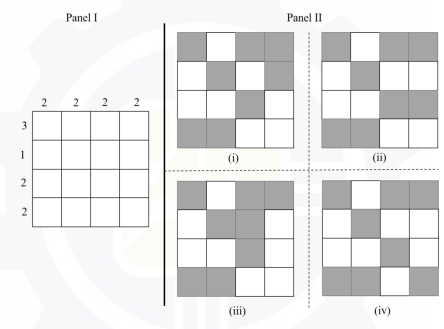
To solve the problem, we need to shade the grid in Panel I according to the numbers on the top (columns) and on the left (rows). Each number indicates how many cells are to be shaded in that column or row.
Step-by-step Solution:
- Look at the top numbers for each column in Panel I: 2, 2, 2, 2. This means each column must have exactly 2 shaded cells.
- Look at the left numbers for each row in Panel I: 3, 1, 2, 2. This means the rows must have 3, 1, 2, and 2 shaded cells respectively.
- Now, we analyze each option in Panel II to find which one correctly follows these rules:
- Option (i):
- First Column: 2 cells shaded, correct.
- Second Column: 3 cells shaded, incorrect.
- Third Column: 3 cells shaded, incorrect.
- Fourth Column: 2 cells shaded, correct.
- Option (ii):
- First Column: 2 cells shaded, correct.
- Second Column: 2 cells shaded, correct.
- Third Column: 2 cells shaded, correct.
- Fourth Column: 2 cells shaded, correct.
- Rows:
- First Row: 3 cells shaded, correct.
- Second Row: 1 cell shaded, correct.
- Third Row: 2 cells shaded, correct.
- Fourth Row: 2 cells shaded, correct.
- Option (iii):
- First Column: 3 cells shaded, incorrect.
- Second Column: 3 cells shaded, incorrect.
- Third Column: 1 cell shaded, incorrect.
- Fourth Column: 3 cells shaded, incorrect.
- Option (iv):
- First Column: 2 cells shaded, correct.
- Second Column: 2 cells shaded, correct.
- Third Column: 1 cell shaded, incorrect.
- Fourth Column: 3 cells shaded, incorrect.
- Option (i):
Therefore, the correct option is (ii), as it satisfies both row and column conditions for shading.
Important Questions from Puzzles
Students applying for hostel rooms are allotted rooms in order of seniority. Students already staying in a room will move if they get a room in their preferred list. Preferences of lower ranked applicants are ignored during allocation.
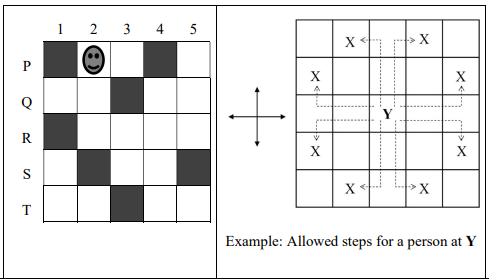
Given the data below, which room will Ajit stay in?Names Student seniority Current room Room preference list Amar 1 P R, S, Q Akbar 2 None R, S Anthony 3 Q P Ajit 4 S Q, P, R In the square grid shown on the left, a person standing at P2 position is required to move to P5 position.
The only movement allowed for a step involves, “two moves along one direction followed by one move in a perpendicular direction”. The permissible directions for movement are shown as dotted arrows in the right.
For example, a person at a given position Y can move only to the positions marked X on the right.
Without occupying any of the shaded squares at the end of each step, the minimum number of steps required to go from P2 to P5 is
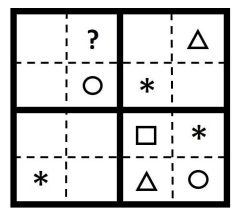
The symbols O, *, $\Delta$ , and $\square$ are to be filled, one in each box, as shown below.
The rules for filling in the four symbols are as follows.
1) Every row and every column must contain each of the four symbols.
2) Every 2$\times$2 square delineated by bold lines must contain each of the four symbols.Which symbol will occupy the box marked with '?' in the partially filled figure?
- A thin wire is used to construct all the edges of a cube of $1 \text{ m}$ side by bending, cutting and soldering the wire. If the wire is $12 \text{ m}$ long, what is the minimum number of cuts required to construct the wire frame to form the cube?
- In the 2020 summer Olympics’ Javelin throw finals, Neeraj Chopra exhibited a spectacular performance to win the gold medal. The silver medal was won by Jakub Vadlejch and the bronze medal was won by Vitezlav Vesely. There were six rounds of throws with each athlete having one throw per round. The best of all the throws of each athlete is considered for the medal. Following were the observations about the throws:
i. The first and second rounds were dominated by Neeraj Chopra with a gold medal performance in his second throw, while the other two athletes did not have any medal winning throws in these rounds.
ii. The throws in the last round by both Jakub Vadlejch and Vitezlav Vesely were fouls and were not considered for scoring.
iii. After four rounds, Vitezlav Vesely was in the second position and could not improve upon his best throw in the succeeding rounds.
iv. In the fourth round, the throw by Jakub Vadlejch was the best in that round.
In which round did Vitezlav Vesely have his best throw?


