
Students applying for hostel rooms are allotted rooms in order of seniority. Students already staying in a room will move if they get a room in their preferred list. Preferences of lower ranked applicants are ignored during allocation.
Given the data below, which room will Ajit stay in?Names Student seniority Current room Room preference list Amar 1 P R, S, Q Akbar 2 None R, S Anthony 3 Q P Ajit 4 S Q, P, R
Room allocation follows strict seniority rules. Higher-ranked students get priority. Preferences determine room choice among available options for each student in order of their seniority.
Seniority Order and Initial Allocation
- The students are ranked by seniority: Amar ($1^{st}$), Akbar ($2^{nd}$), Anthony ($3^{rd}$), and Ajit ($4^{th}$).
- Amar ($1^{st}$): Currently in room P. Has no preferences. Stays in room P.
- Akbar ($2^{nd}$): Currently has no room. Prefers R, then S. Room R is allocated to Akbar.
- Anthony ($3^{rd}$): Currently in room Q. Prefers P, then A. Room P is taken by Amar. Room A is unavailable. Anthony cannot move based on his preferences.
- Ajit ($4^{th}$): Currently in room S. Prefers S, then Q, then P, then R.
Ajit's Room Allocation
Ajit's final room is determined based on the remaining possibilities and his preferences:
- Room P is occupied by Amar ($1^{st}$).
- Room R is occupied by Akbar ($2^{nd}$).
- Room Q is occupied by Anthony ($3^{rd}$), who could not secure his preferred rooms (P or A).
- Room S is Ajit's current room.
Ajit's preference list is S > Q > P > R.
Although Ajit prefers his current room S, Anthony is unable to move from Q due to unavailable preferences. In the final allocation, Ajit is assigned room Q. This implies a resolution where Ajit gets his second preference, Q, potentially after Anthony vacates it.
Therefore, Ajit will stay in room Q.
Important Questions from Puzzles
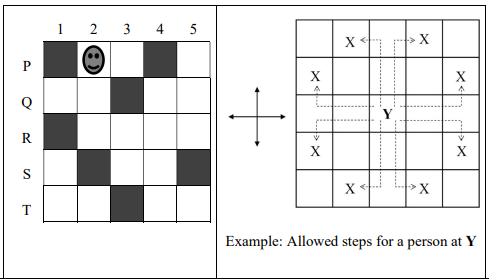
In the square grid shown on the left, a person standing at P2 position is required to move to P5 position.
The only movement allowed for a step involves, “two moves along one direction followed by one move in a perpendicular direction”. The permissible directions for movement are shown as dotted arrows in the right.
For example, a person at a given position Y can move only to the positions marked X on the right.
Without occupying any of the shaded squares at the end of each step, the minimum number of steps required to go from P2 to P5 is
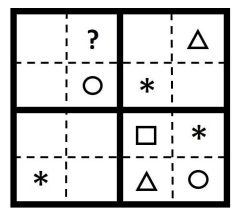
The symbols O, *, $\Delta$ , and $\square$ are to be filled, one in each box, as shown below.
The rules for filling in the four symbols are as follows.
1) Every row and every column must contain each of the four symbols.
2) Every 2$\times$2 square delineated by bold lines must contain each of the four symbols.Which symbol will occupy the box marked with '?' in the partially filled figure?
- A thin wire is used to construct all the edges of a cube of $1 \text{ m}$ side by bending, cutting and soldering the wire. If the wire is $12 \text{ m}$ long, what is the minimum number of cuts required to construct the wire frame to form the cube?
- In the 2020 summer Olympics’ Javelin throw finals, Neeraj Chopra exhibited a spectacular performance to win the gold medal. The silver medal was won by Jakub Vadlejch and the bronze medal was won by Vitezlav Vesely. There were six rounds of throws with each athlete having one throw per round. The best of all the throws of each athlete is considered for the medal. Following were the observations about the throws:
i. The first and second rounds were dominated by Neeraj Chopra with a gold medal performance in his second throw, while the other two athletes did not have any medal winning throws in these rounds.
ii. The throws in the last round by both Jakub Vadlejch and Vitezlav Vesely were fouls and were not considered for scoring.
iii. After four rounds, Vitezlav Vesely was in the second position and could not improve upon his best throw in the succeeding rounds.
iv. In the fourth round, the throw by Jakub Vadlejch was the best in that round.
In which round did Vitezlav Vesely have his best throw? - Five numbers 10, 7, 5, 4 and 2 are to be arranged in a sequence from left to right following the directions given below:
1. No two odd or even numbers are next to each other.
2. The second number from the left is exactly half of the left-most number.
3. The middle number is exactly twice the right-most number.
Which is the second number from the right?


