
The energy, $\varepsilon_k$ for band electrons as a function of the wave vector, $k$ in the first Brillouin zone ($- \pi/a \le k \le \pi/a$) of a one dimensional monatomic lattice is shown as ($a$ is lattice constant) The variation of the group velocity 𝑣$_𝑘$ is most appropriately represented by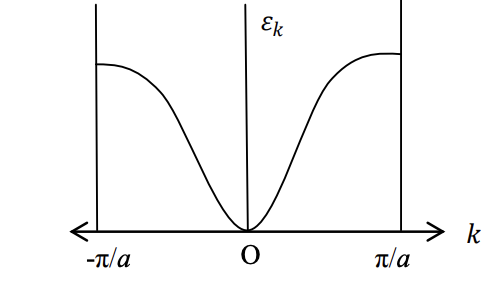
To determine the variation of the group velocity vkvk for band electrons in the given scenario, we need to consider the relationship between the energy εkεk and the wave vector kk.
The group velocity vkvk is defined as the derivative of energy with respect to the wave vector:
\(v_k = \frac{d\varepsilon_k}{dk}\)
In the provided graph, εkεk is a symmetric function of kk with a minimum at k=0k=0 and increases towards the edges (−π/a,π/a)(−π/a,π/a).
To identify the correct behavior of vkvk, consider the following points:
- At k=0k=0 (the center of the Brillouin zone), the slope of the energy curve is zero, meaning vk=0vk=0.
- As you move away from k=0k=0 towards ±π/a±π/a, the slope (derivative) increases in magnitude, indicating that the group velocity increases.
- Because εkεk is symmetric, vkvk is also symmetric about k=0k=0.
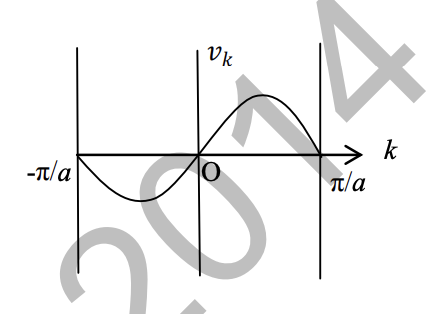
Thus, the graph of vkvk is zero at k=0k=0, positively rising as kk moves towards π/aπ/a and negatively as kk moves towards −π/a−π/a.
The correct graph of the group velocity vkvk is shown in the second option:
Important Questions from Band Theory Effective Mass Holes
- For the energy dispersion of an electron in a one-dimensional solid $E(k) = E_0 - 2\gamma \cos(ka)$, the ratio of the effective mass of the electron in the solid to the free electron mass ($m_e$) at $k = 0$ is $R_0$. Taking $\gamma = 0.5 \text{ eV}$ and $a = 0.5 \text{ nm}$, the value of $R_0$ (rounded off to two decimal place) is _____
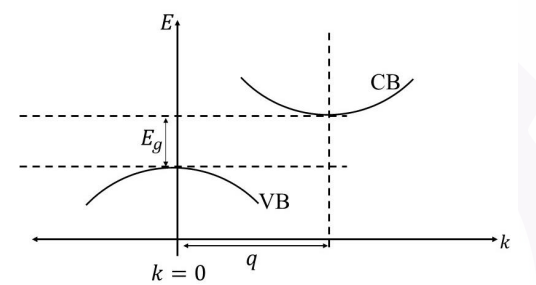
($\hbar = 1.054 \times 10^{-34} \text{ J.s}$, $m_e = 9.1 \times 10^{-31} \text{ kg}$, electron charge $= 1.6 \times 10^{-19} \text{ C}$) The dispersion ($E(k)$) of the conduction band (CB) and valence band (VB) for a semiconductor are shown schematically in the figure. Considering the possibility of an electron making a transition from the bottom of the CB to the top of the VB, which of the following options is/are correct?
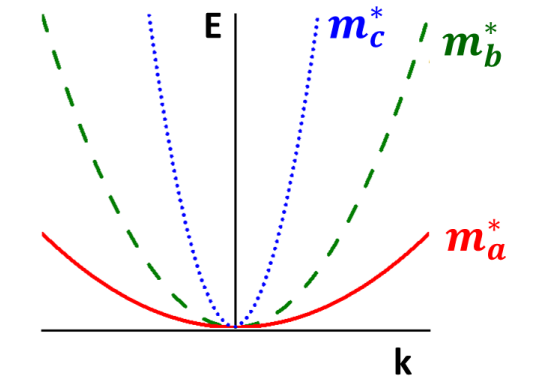
For nonrelativistic electrons in a solid, different energy dispersion relations (with effective masses $m_a^*$, $m_b^*$, and $m_c^*$) are schematically shown in the plots. Which one of the following options is CORRECT?
The temperature dependence of the electrical conductivity ($\sigma$) of three intrinsic semiconductors A, B and C is shown in figure.
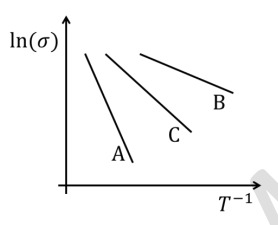
Let $E_A$, $E_B$ and $E_C$ be the bandgaps of A, B and C, respectively. Which one of the following relations is correct?- The energy dispersion for electrons in one dimensional lattice with lattice parameter $a$ is given by $E(k) = E_0 - \frac{1}{2} W \cos ka$, where $W$ and $E_0$ are constants. The effective mass of the electron near the bottom of the band is


