
The dispersion ($E(k)$) of the conduction band (CB) and valence band (VB) for a semiconductor are shown schematically in the figure. Considering the possibility of an electron making a transition from the bottom of the CB to the top of the VB, which of the following options is/are correct?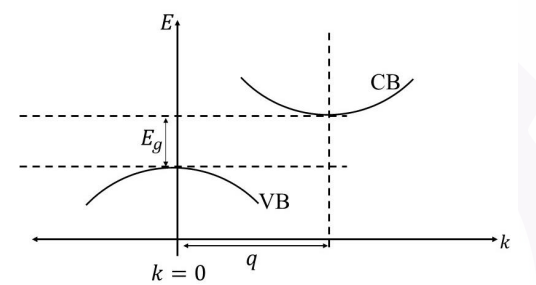
The given question involves understanding electron transitions between the conduction band (CB) and valence band (VB) in a semiconductor, centered around the concept of energy transitions and conservation laws.
Let's evaluate the options given in terms of energy and momentum conservation:
The transition is forbidden.
The transition from the bottom of the CB to the top of the VB involves a change in momentum, characterized in this diagram by \(k\) (wave vector), indicating that the transitions are not direct. As a direct transition usually involves vertical transitions (where momentum remains constant), this might not correctly apply here.
A photon can be emitted with an energy exactly equal to \(E_g\).
Schematic shows an indirect band gap, and for such semiconductors, photon emissions are not typically at \(E_g\) due to momentum conservation constraints. An accompanying phonon is usually involved to conserve momentum, making this unlikely.
A photon can be emitted with an energy less than \(E_g\).
In indirect band gap semiconductors, photon emissions typically occur with energies less than \(E_g\), due to additional energy adjustments usually mediated by phonons. This option aligns with physical expectations for such transitions.
A phonon can be created with a crystal momentum \(\hbar q\).
Phonons are quanta of lattice vibrations that allow transitions with a change in momentum to take place in indirect transitions. Thus, phonons with momentum \(\hbar q\) are typically involved, making this option plausible.
Based on these evaluations:
- The transitions are not forbidden, but involve indirect processes.
- Emission of a photon exactly at \(E_g\) without simultaneous phonon interaction is unlikely.
- The correct answers are: "A photon can be emitted with an energy less than \(E_g\)" and "A phonon can be created with a crystal momentum \(\hbar q\)".
Important Questions from Band Theory Effective Mass Holes
- For the energy dispersion of an electron in a one-dimensional solid $E(k) = E_0 - 2\gamma \cos(ka)$, the ratio of the effective mass of the electron in the solid to the free electron mass ($m_e$) at $k = 0$ is $R_0$. Taking $\gamma = 0.5 \text{ eV}$ and $a = 0.5 \text{ nm}$, the value of $R_0$ (rounded off to two decimal place) is _____
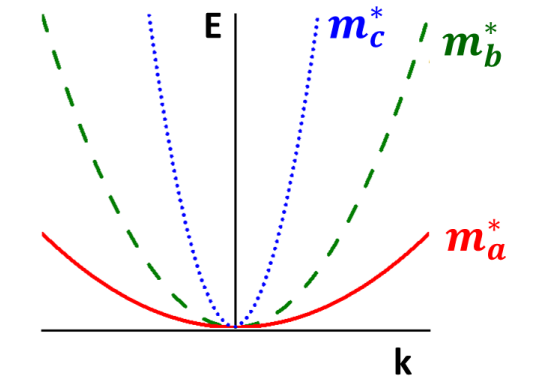
($\hbar = 1.054 \times 10^{-34} \text{ J.s}$, $m_e = 9.1 \times 10^{-31} \text{ kg}$, electron charge $= 1.6 \times 10^{-19} \text{ C}$) For nonrelativistic electrons in a solid, different energy dispersion relations (with effective masses $m_a^*$, $m_b^*$, and $m_c^*$) are schematically shown in the plots. Which one of the following options is CORRECT?
The temperature dependence of the electrical conductivity ($\sigma$) of three intrinsic semiconductors A, B and C is shown in figure.
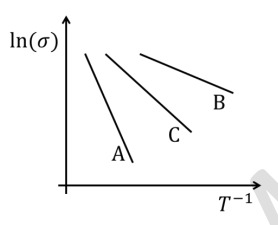
Let $E_A$, $E_B$ and $E_C$ be the bandgaps of A, B and C, respectively. Which one of the following relations is correct?- The energy dispersion for electrons in one dimensional lattice with lattice parameter $a$ is given by $E(k) = E_0 - \frac{1}{2} W \cos ka$, where $W$ and $E_0$ are constants. The effective mass of the electron near the bottom of the band is
- Consider a one-dimensional non-magnetic crystal with one atom per unit cell. Assume that the valence electrons (i) do not interact with each other and (ii) interact weakly with the ions. If $n$ is the number of valence electrons per unit cell, then at 0 K,


