
Analyzing 1D Crystal Conductivity based on Valence Electrons
This problem concerns the electrical properties of a simplified one-dimensional (1D) crystal at absolute zero temperature (0 K). The crystal is non-magnetic, has one atom per unit cell, and its valence electrons exhibit independent behavior and weak interaction with the ionic lattice. We need to determine the condition under which the crystal behaves metallically based on the number of valence electrons per unit cell, denoted by $n$. The behavior depends crucially on how the available energy bands are filled.
Band Structure and Filling in 1D Crystals
In a 1D crystal with a periodic potential, energy bands are formed. The interaction with the ions, even if weak, creates small energy gaps at the boundaries of the Brillouin zone (specifically at $k = \pm \pi/a$, where $a$ is the lattice constant). A single energy band can accommodate a maximum of two electrons per unit cell, one for each spin state (spin up and spin down).
A crystal is considered:
- Metallic: If the highest occupied energy band at 0 K is only partially filled. This allows electrons to move into nearby unoccupied states within the same band, enabling electrical conduction.
- Non-metallic (Insulator or Semiconductor): If the highest occupied energy band is completely filled, and there is an energy gap separating it from the next higher, empty band.
Determining Metallic Behavior Based on Valence Electron Count ($n$)
We analyze the filling of energy bands based on the number of valence electrons per unit cell, $n$. Since each band can hold 2 electrons per unit cell:
- If $n$ is odd: Let $n = 2m + 1$ for some integer $m \geq 0$. The first $m$ bands will be completely filled (containing $2m$ electrons). The remaining electron(s) will partially fill the next band (the $(m+1)$-th band). A partially filled band implies metallic behavior.
- If $n$ is even: Let $n = 2m$ for some integer $m \geq 1$. The first $m$ bands will be completely filled (containing $2m$ electrons). The highest occupied band is therefore completely filled. Assuming a band gap exists above this filled band (due to the weak ion interaction), the crystal will behave non-metallically.
Conclusion
Based on the band filling analysis at 0 K:
- The crystal is metallic when $n$ is odd.
- The crystal is non-metallic when $n$ is even.
Therefore, the condition for the crystal to be metallic is that $n$ must be odd.
Important Questions from Band Theory Effective Mass Holes
- For the energy dispersion of an electron in a one-dimensional solid $E(k) = E_0 - 2\gamma \cos(ka)$, the ratio of the effective mass of the electron in the solid to the free electron mass ($m_e$) at $k = 0$ is $R_0$. Taking $\gamma = 0.5 \text{ eV}$ and $a = 0.5 \text{ nm}$, the value of $R_0$ (rounded off to two decimal place) is _____
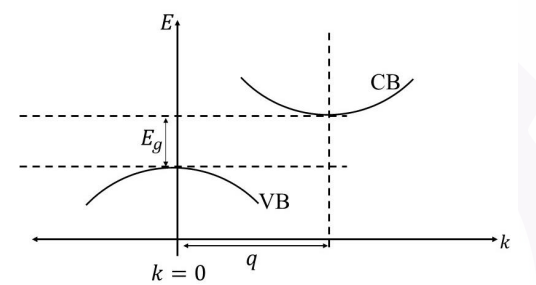
($\hbar = 1.054 \times 10^{-34} \text{ J.s}$, $m_e = 9.1 \times 10^{-31} \text{ kg}$, electron charge $= 1.6 \times 10^{-19} \text{ C}$) The dispersion ($E(k)$) of the conduction band (CB) and valence band (VB) for a semiconductor are shown schematically in the figure. Considering the possibility of an electron making a transition from the bottom of the CB to the top of the VB, which of the following options is/are correct?
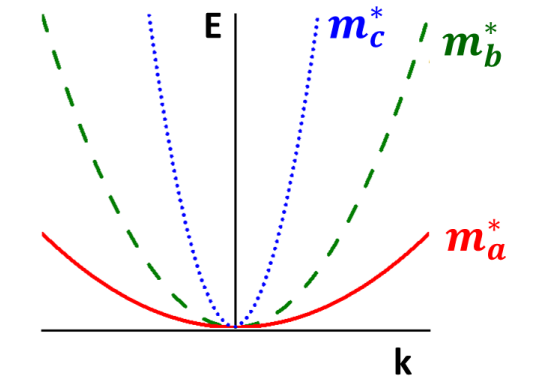
For nonrelativistic electrons in a solid, different energy dispersion relations (with effective masses $m_a^*$, $m_b^*$, and $m_c^*$) are schematically shown in the plots. Which one of the following options is CORRECT?
The temperature dependence of the electrical conductivity ($\sigma$) of three intrinsic semiconductors A, B and C is shown in figure.
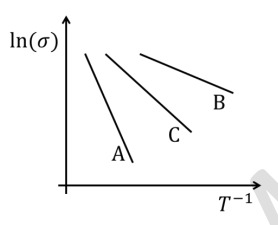
Let $E_A$, $E_B$ and $E_C$ be the bandgaps of A, B and C, respectively. Which one of the following relations is correct?- The energy dispersion for electrons in one dimensional lattice with lattice parameter $a$ is given by $E(k) = E_0 - \frac{1}{2} W \cos ka$, where $W$ and $E_0$ are constants. The effective mass of the electron near the bottom of the band is


