
For nonrelativistic electrons in a solid, different energy dispersion relations (with effective masses $m_a^*$, $m_b^*$, and $m_c^*$) are schematically shown in the plots. Which one of the following options is CORRECT?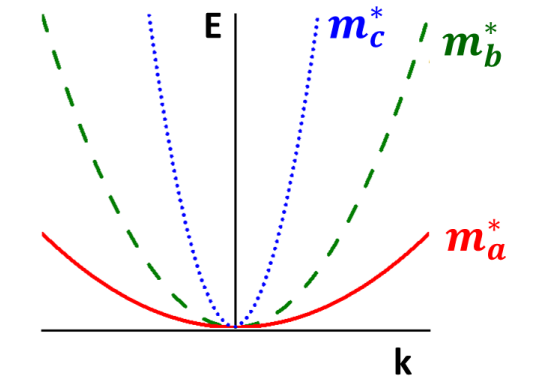
To determine the correct option, we need to analyze the energy dispersion relations for nonrelativistic electrons in a solid and find how they relate to the effective masses \(m_a^*\), \(m_b^*\), and \(m_c^*\).
The energy dispersion relation for an electron is given by:
\(E = \frac{\hbar^2 k^2}{2m^*}\)
where \(E\) is the energy, \(k\) is the wave vector, \(\hbar\) is the reduced Planck's constant, and \(m^*\) is the effective mass of the electron.
From the equation, it is clear that the curvature of the dispersion relation in the \(E\) vs. \(k\) plot is inversely related to the effective mass:
- Larger curvature (steeper curve) implies a smaller effective mass.
- Smaller curvature (flatter curve) implies a larger effective mass.
Looking at the given plot:
- The red curve \(m_a^*\) is the flattest, indicating the largest effective mass.
- The green curve \(m_b^*\) has moderate curvature, indicating a moderate effective mass.
- The blue curve \(m_c^*\) is the steepest, indicating the smallest effective mass.
From this analysis, we conclude:
- \(m_a^* \gt m_b^* \gt m_c^*\)
Therefore, the correct option is:
- \(m_a^* \gt m_b^* \gt m_c^*\)
Important Questions from Band Theory Effective Mass Holes
- For the energy dispersion of an electron in a one-dimensional solid $E(k) = E_0 - 2\gamma \cos(ka)$, the ratio of the effective mass of the electron in the solid to the free electron mass ($m_e$) at $k = 0$ is $R_0$. Taking $\gamma = 0.5 \text{ eV}$ and $a = 0.5 \text{ nm}$, the value of $R_0$ (rounded off to two decimal place) is _____
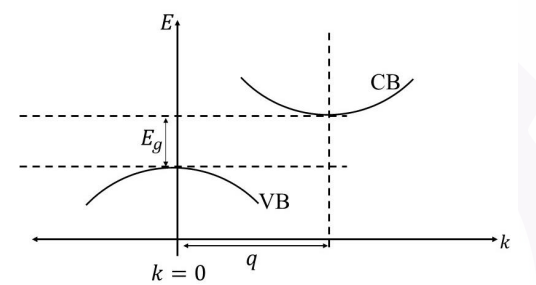
($\hbar = 1.054 \times 10^{-34} \text{ J.s}$, $m_e = 9.1 \times 10^{-31} \text{ kg}$, electron charge $= 1.6 \times 10^{-19} \text{ C}$) The dispersion ($E(k)$) of the conduction band (CB) and valence band (VB) for a semiconductor are shown schematically in the figure. Considering the possibility of an electron making a transition from the bottom of the CB to the top of the VB, which of the following options is/are correct?
The temperature dependence of the electrical conductivity ($\sigma$) of three intrinsic semiconductors A, B and C is shown in figure.
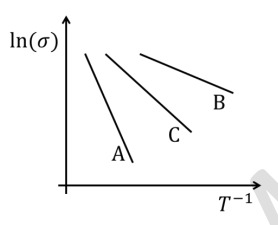
Let $E_A$, $E_B$ and $E_C$ be the bandgaps of A, B and C, respectively. Which one of the following relations is correct?- The energy dispersion for electrons in one dimensional lattice with lattice parameter $a$ is given by $E(k) = E_0 - \frac{1}{2} W \cos ka$, where $W$ and $E_0$ are constants. The effective mass of the electron near the bottom of the band is
- Consider a one-dimensional non-magnetic crystal with one atom per unit cell. Assume that the valence electrons (i) do not interact with each other and (ii) interact weakly with the ions. If $n$ is the number of valence electrons per unit cell, then at 0 K,


