
($\hbar = 1.054 \times 10^{-34} \text{ J.s}$, $m_e = 9.1 \times 10^{-31} \text{ kg}$, electron charge $= 1.6 \times 10^{-19} \text{ C}$)
Electron Effective Mass Calculation
The effective mass $m^*$ of an electron in a solid quantifies its inertial response within the crystal lattice, deviating from its free-space mass $m_e$. This deviation arises from the interaction with the periodic potential, and it is directly related to the curvature of the electron's energy band structure, $E(k)$. A smaller curvature (larger second derivative of $E$ with respect to $k$) implies a larger effective mass.
Effective Mass Formula
The effective mass $m^*(k)$ at a given wavevector $k$ is defined by the formula:
$m^*(k) = \frac{\hbar^2}{\frac{d^2E(k)}{dk^2}}$
Here, $\hbar$ is the reduced Planck constant, and $\frac{d^2E(k)}{dk^2}$ represents the second derivative of the energy dispersion relation $E(k)$ with respect to the wavevector $k$. The unit of effective mass is typically mass (e.g., kg).
Deriving Effective Mass at k=0
The given energy dispersion relation for an electron in a one-dimensional solid is:
$E(k) = E_0 - 2\gamma \cos(ka)$
To find the effective mass, we first need to compute the second derivative of $E(k)$ with respect to $k$. The first derivative is:
$\frac{dE}{dk} = \frac{d}{dk}(E_0 - 2\gamma \cos(ka)) = -2\gamma (-\sin(ka)) \cdot a = 2\gamma a \sin(ka)$
The second derivative is:
$\frac{d^2E}{dk^2} = \frac{d}{dk}(2\gamma a \sin(ka)) = 2\gamma a (\cos(ka)) \cdot a = 2\gamma a^2 \cos(ka)$
Substituting this into the effective mass formula gives:
$m^*(k) = \frac{\hbar^2}{2\gamma a^2 \cos(ka)}$
We are interested in the effective mass at $k=0$. Substituting $k=0$ into the expression for $m^*(k)$:
$m^*(0) = \frac{\hbar^2}{2\gamma a^2 \cos(0)} = \frac{\hbar^2}{2\gamma a^2}$
since $\cos(0) = 1$.
Calculating the Ratio $R_0$
The question asks for the ratio ($R_0$) of the effective mass of the electron at $k=0$ ($m^*(0)$) to the free electron mass ($m_e$).
$R_0 = \frac{m^*(0)}{m_e} = \frac{\hbar^2}{2\gamma a^2 m_e}$
This ratio is dimensionless.
Numerical Calculation
We are given the following values:
- Reduced Planck constant, $\hbar = 1.054 \times 10^{-34} \text{ J}\cdot\text{s}$
- Energy parameter, $\gamma = 0.5 \text{ eV}$
- Lattice constant, $a = 0.5 \text{ nm} = 0.5 \times 10^{-9} \text{ m}$
- Free electron mass, $m_e = 9.1 \times 10^{-31} \text{ kg}$
- Electron charge, $e = 1.6 \times 10^{-19} \text{ C}$ (used for unit conversion)
First, convert $\gamma$ from electronvolts (eV) to Joules (J):
$\gamma = 0.5 \text{ eV} \times (1.602 \times 10^{-19} \text{ J/eV}) \approx 0.801 \times 10^{-19} \text{ J}$
Now, substitute all values into the formula for $R_0$:
$R_0 = \frac{(1.054 \times 10^{-34} \text{ J}\cdot\text{s})^2}{2 \times (0.801 \times 10^{-19} \text{ J}) \times (0.5 \times 10^{-9} \text{ m})^2 \times (9.1 \times 10^{-31} \text{ kg})}$
Calculate the square of $\hbar$:
$\hbar^2 = (1.054 \times 10^{-34})^2 \approx 1.1109 \times 10^{-68} \text{ J}^2\text{s}^2$
Calculate the denominator:
$2\gamma a^2 m_e = 2 \times (0.801 \times 10^{-19} \text{ J}) \times (0.25 \times 10^{-18} \text{ m}^2) \times (9.1 \times 10^{-31} \text{ kg})$
$2\gamma a^2 m_e = (2 \times 0.801 \times 0.25 \times 9.1) \times 10^{-19-18-31} \text{ J m}^2 \text{ kg}$
$2\gamma a^2 m_e \approx 3.6446 \times 10^{-68} \text{ J m}^2 \text{ kg}$
Now, compute $R_0$:
$R_0 = \frac{1.1109 \times 10^{-68} \text{ J}^2\text{s}^2}{3.6446 \times 10^{-68} \text{ J m}^2 \text{ kg}}$
Using the relationship $1 \text{ J} = 1 \text{ kg}\cdot\text{m}^2/\text{s}^2$, the units cancel out correctly to give a dimensionless ratio.
$R_0 \approx 0.30478$
Rounding the result to two decimal places gives $0.30$.
Important Questions from Band Theory Effective Mass Holes
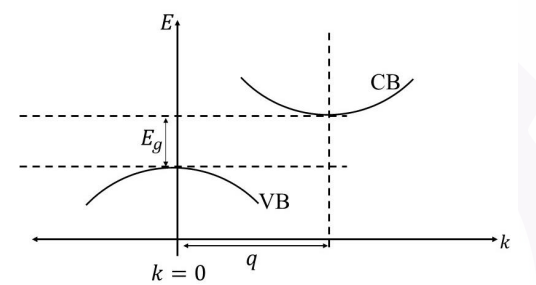
The dispersion ($E(k)$) of the conduction band (CB) and valence band (VB) for a semiconductor are shown schematically in the figure. Considering the possibility of an electron making a transition from the bottom of the CB to the top of the VB, which of the following options is/are correct?
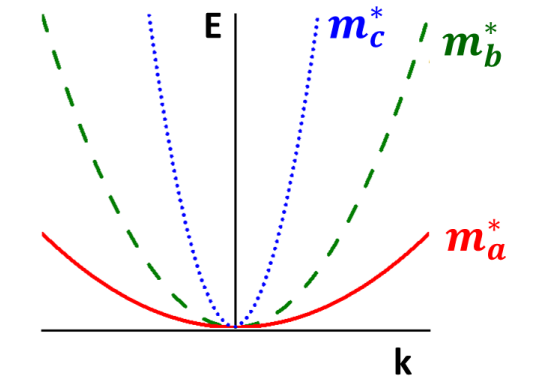
For nonrelativistic electrons in a solid, different energy dispersion relations (with effective masses $m_a^*$, $m_b^*$, and $m_c^*$) are schematically shown in the plots. Which one of the following options is CORRECT?
The temperature dependence of the electrical conductivity ($\sigma$) of three intrinsic semiconductors A, B and C is shown in figure.
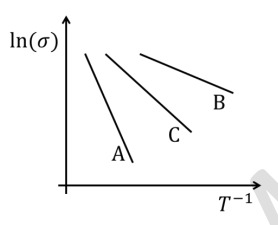
Let $E_A$, $E_B$ and $E_C$ be the bandgaps of A, B and C, respectively. Which one of the following relations is correct?- The energy dispersion for electrons in one dimensional lattice with lattice parameter $a$ is given by $E(k) = E_0 - \frac{1}{2} W \cos ka$, where $W$ and $E_0$ are constants. The effective mass of the electron near the bottom of the band is
- Consider a one-dimensional non-magnetic crystal with one atom per unit cell. Assume that the valence electrons (i) do not interact with each other and (ii) interact weakly with the ions. If $n$ is the number of valence electrons per unit cell, then at 0 K,


