Calculating Cylinder Density Fractional Error
The density ($\rho$) of a uniform cylinder is given by the formula:
$ \rho = \frac{\text{Mass}}{\text{Volume}} = \frac{m}{V} $
The volume ($V$) of a cylinder is calculated using its length ($l$) and radius ($r$):
$ V = \pi r^2 l $
Since the diameter ($d$) is given, the radius is $r = \frac{d}{2}$. Substituting this into the volume formula:
$ V = \pi \left(\frac{d}{2}\right)^2 l = \frac{\pi d^2 l}{4} $
Now, substitute the volume formula back into the density formula:
$ \rho = \frac{m}{\frac{\pi d^2 l}{4}} = \frac{4m}{\pi d^2 l} $
Determining Fractional Error
To find the fractional error in density ($\frac{\Delta \rho}{\rho}$), we use the error propagation rules for multiplication and division. Constants like $4$ and $\pi$ do not contribute to the error. The formula becomes:
$ \frac{\Delta \rho}{\rho} = \frac{\Delta m}{m} + 2 \frac{\Delta d}{d} + \frac{\Delta l}{l} $
We are given the following measurements:
- Mass ($m$): $97.42 \pm 0.02$ g
- Length ($l$): $8.35 \pm 0.05$ mm
- Diameter ($d$): $20.20 \pm 0.02$ mm
Calculating Individual Fractional Errors
- Fractional error in mass ($\frac{\Delta m}{m}$):
$ \frac{\Delta m}{m} = \frac{0.02}{97.42} \approx 0.000205 $
- Fractional error in diameter ($\frac{\Delta d}{d}$):
$ \frac{\Delta d}{d} = \frac{0.02}{20.20} \approx 0.000990 $
- Fractional error in length ($\frac{\Delta l}{l}$):
$ \frac{\Delta l}{l} = \frac{0.05}{8.35} \approx 0.005988 $
Calculating Total Fractional Error and Percentage Error
Now, substitute these values into the total fractional error formula:
$ \frac{\Delta \rho}{\rho} = \frac{\Delta m}{m} + 2 \frac{\Delta d}{d} + \frac{\Delta l}{l} $
$ \frac{\Delta \rho}{\rho} \approx 0.000205 + 2 \times (0.000990) + 0.005988 $
$ \frac{\Delta \rho}{\rho} \approx 0.000205 + 0.001980 + 0.005988 $
$ \frac{\Delta \rho}{\rho} \approx 0.008173 $
To find the percentage fractional error, multiply by 100%:
$ \text{Percentage Error} = \frac{\Delta \rho}{\rho} \times 100\% \approx 0.008173 \times 100\% \approx 0.8173\% $
Rounding to two decimal places gives 0.82%.
Similar Questions
- The characteristic distance at which quantum gravitational effects are significant, the Planck length, can be determined from a suitable combination of the fundamental physical constants G, $\hbar$ and c. Which of the following correctly gives the Planck length ?
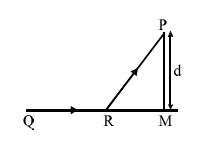
A man in a car at location Q on a straight highway is moving with speed v. He decides to reach a point P in qa field at a distance d from the highway (point m) as shown in the figure. Speed of the car in the field is half to that on the highway. What should be the distance RM, so that the time taken to reach P is minimum ?
- Three particles P, Q and R are moving along the vectors $\vec{A} = \hat{i} + \hat{j}$, $\vec{B} = \hat{j} + \hat{k}$ and $\vec{C} = -\hat{i} + \hat{j}$ respectively. They strike on a point and start to move in different directions.<br>Now particle P is moving normal to the plane which contains vector $\vec{A}$ and $\vec{B}$. Similarly particle Q is moving normal to the plane which contains vector $\vec{A}$ and $\vec{C}$. The angle between the direction of motion of P and Q is $\cos^{-1}\left(\frac{1}{\sqrt{x}}\right)$. Then the value of x is __________.
Three students $S_1$, $S_2$ and $S_3$ perform an experiment for determining the acceleration due to gravity (g) using a simple pendulum. They use different lengths of pendulum and record time for different number of oscillations. The observations are as shown in the table.
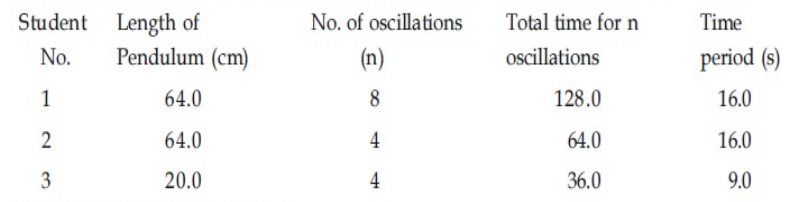
(least count of length =0.1 cm
least count for time =0.1s )
If $E_1$, $E_2$ and $E_3$ are the percentage errors in 'g' for students 1, 2 and 3 respectively, then the minimum percentage error is obtained by student no. __________.
- When the position vector $\overrightarrow{r} = x\hat{i} + y\hat{j} + z\hat{k}$ changes sign as $-\overrightarrow{r}$, which one of the following vector will not flip under sign change ?
- Keeping the significant figures in view, the sum of the physical quantities $52.01\text{ m}$, $153.2\text{ m}$ and $0.123\text{ m}$ is :
The diameter of a wire measured by a screw gauge of least count $0.001\text{ cm}$ is $0.08\text{ cm}$. The length measured by a scale of least count $0.1\text{ cm}$ is $150\text{ cm}$. When a weight of $100\text{ N}$ is applied to the wire, the extension in length is $0.5\text{ cm}$, measured by a micrometer of least count $0.001\text{ cm}$. The error in the measured Young's modulus is $\alpha \times 10^9\text{ N/m}^2$. The value of $\alpha$ is ________.
(Ignore the contribution of the load to Young's modulus error calculation)- For three unit vectors $\vec{a}, \vec{b}, \vec{c}$ satisfying $|\vec{a}-\vec{b}|^2 + |\vec{b}-\vec{c}|^2 + |\vec{c}-\vec{a}|^2 = 9$ and $|2\vec{a}+k\vec{b}+k\vec{c}| = 3$, the positive value of k is
- Let PQR be a triangle such that $\vec{PQ} = -2\hat{i} - \hat{j} + 2\hat{k}$ and $\vec{PR} = a\hat{i} + b\hat{j} - 4\hat{k}$, $a, b \in \mathbb{Z}$. Let S be the point on QR, which is equidistant from the lines PQ and PR. If $|\vec{PR}| = 9$ and $\vec{PS} = \hat{i} - 7\hat{j} + 2\hat{k}$, then the value of $3a - 4b$ is ________
- Consider the equation $H = \frac{x^p \epsilon^q E^r}{t^s}$
Where $H = $ magnetic field; $E = $ electric field, $\epsilon = $ permittivity, $x = $ distance, $t = $ time
The values of $p, q, r$ and $s$ respectively are :
Important Questions from General Physics
- Density and volume of a body are given as $(20 \pm 4)\text{ gm/cm}^3$ and $(10 \pm 1)\text{ cm}^3$ respectively. The absolute error in measurement of mass is
- The velocity $v$ of a particle at time $t$ is given by $v = at + \frac{b}{t+c}$, where $a$, $b$ and $c$ are constants. The dimension of $a$, $b$ and $c$ are, respectively
- The characteristic distance at which quantum gravitational effects are significant, the Planck length, can be determined from a suitable combination of the fundamental physical constants G, $\hbar$ and c. Which of the following correctly gives the Planck length ?
A man in a car at location Q on a straight highway is moving with speed v. He decides to reach a point P in qa field at a distance d from the highway (point m) as shown in the figure. Speed of the car in the field is half to that on the highway. What should be the distance RM, so that the time taken to reach P is minimum ?
- Three particles P, Q and R are moving along the vectors $\vec{A} = \hat{i} + \hat{j}$, $\vec{B} = \hat{j} + \hat{k}$ and $\vec{C} = -\hat{i} + \hat{j}$ respectively. They strike on a point and start to move in different directions.<br>Now particle P is moving normal to the plane which contains vector $\vec{A}$ and $\vec{B}$. Similarly particle Q is moving normal to the plane which contains vector $\vec{A}$ and $\vec{C}$. The angle between the direction of motion of P and Q is $\cos^{-1}\left(\frac{1}{\sqrt{x}}\right)$. Then the value of x is __________.