$\sin\theta = \frac{m\lambda}{a}$
in case, light from the entire slit arrives at point of observation in phase, for a bright band $\sin\theta$ is equal to:
Single Slit Diffraction Bright Fringe Condition
In single-slit diffraction, the pattern of bright and dark fringes is formed due to the interference of light waves originating from different parts of the slit.
The condition for the central bright fringe is uniquely defined by the statement that "light from the entire slit arrives at the point of observation in phase". This occurs when the path difference from all parts of the slit to the observation point is zero. This happens directly opposite the center of the slit, corresponding to an angle of observation $\theta = 0$.
For the central bright fringe:
- The angle $\theta = 0$.
- Therefore, $\sin\theta = \sin(0) = 0$.
While the formula $\sin\theta = \frac{m\lambda}{a}$ is provided for dark fringes (minima), the condition for the central bright fringe (principal maximum) where light rays arrive in phase is always $\sin\theta = 0$.
Thus, for a bright band where light arrives in phase, $\sin\theta$ is equal to 0.
Similar Questions
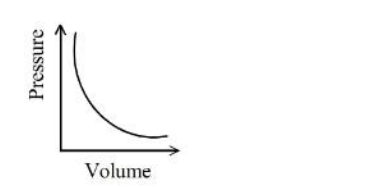
This curve is drawn for a given mass of a gas. This curve represents an:
- Number of degree of Freedom of a molecule of Oxygen (O$_2$) gas is:
- If '$\omega$' is the angler frequency and 'k' is the wave number represents a photon of energy E and momentum 'P' through the wave function E$_y$ (x, t) = A $\sin$ (kx$-\omega$t)
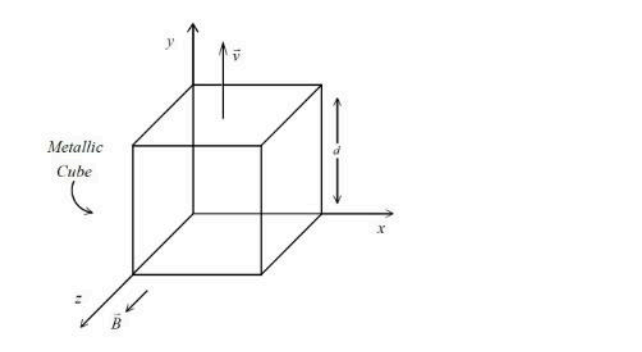
Which of the following relation is true: $\vec{B}$ is constant, No current in the cube. Cube is moving with '$\vec{v}$' velocity. The direction of electric force on the electron inside this cube is:
- Proton is discovered by
- Electron is discovered by
- Given below are two statements: one is labelled as Assertion A and the other is labelled as Reason R
Assertion A: Curl of electric field is zero
Reason R: Linear integral of electric filed around a closed path is evidently zero.
In the light of the above statements, choose the most appropriate answer from the options given below - Given below are two statements: one is labelled as Assertion A and the other is labelled as Reason R
Assertion A: A conductor is an equipotential
Reason R: $\nabla \cdot \vec{B} = 0$, $\vec{B}$ is magnetic field
In the light of the above statements, choose the most appropriate answer from the options given below - ________ dyes are salts of sulfonic or carboxylic acids. They are used to dye fibers with basic groups such as wool, silk and polyamides.
- Given below are two statements: one is labelled as Assertion A and the other is labelled as Reason R
Assertion A: Failure to achieve expected height/length as compared to healthy, well nourished children of the same age is a sign of stunting.
Reason R: Stunting represents a recent failure to receive adequate nutrition such as due to acute diarrhoea.
In the light of the above statements, choose the most appropriate answer from the options given below
Important Questions from Mixed Topic (CUET PG)
- Who was the founder of Bolshevik Communist party?
- What is the key guide to statecraft in the realist tradition?
- Chronologically arrange the events in the Cold War period.
A. Berlin Wall is constructed
B. Communist China joins the UN
C. Soviet invasion of Czechoslovakia
D. Berlin Blockade
Choose the correct answer from the options given below: Morgenthau's principles of political realism are:
A. Politics is rooted in permanent and unchanging human nature which is basically self centred, self-regarding and self-interested
B. Politics is an autonomous sphere of action and cannot therefore be reduced to morals
C. International Politics is an arena of conflicting self-interests
D. The ethics of international relations is situational ethics which is very different from private morality
Choose the correct answer from the options given below:Who among the following political thinkers consider the anarchical self help system to be a compelling factor for States to maximise their relative power positions?