
The complex function
$e^{-\left(\frac{2}{z-1}\right)}$
has __________________
To understand the behavior of the function $f(z) = e^{-\left(\frac{2}{z-1}\right)}$ at $z = 1$, we examine its Laurent series expansion around $z = 1$.
Analyzing the Singularity at z = 1
Let $w = \frac{2}{z-1}$. As $z \to 1$, the term $z-1 \to 0$, and thus $w \to \infty$. The function becomes $f(z) = e^{-w}$.
The Taylor series for $e^x$ around $x=0$ is $e^x = \sum_{n=0}^{\infty} \frac{x^n}{n!}$.
Substituting $x = -\frac{2}{z-1}$, we get the Laurent series for $f(z)$ around $z=1$: $f(z) = e^{-\left(\frac{2}{z-1}\right)} = \sum_{n=0}^{\infty} \frac{\left(-\frac{2}{z-1}\right)^n}{n!} = \sum_{n=0}^{\infty} \frac{(-2)^n}{n!} (z-1)^{-n}$ Expanding this series: $f(z) = \frac{(-2)^0}{0!} (z-1)^0 + \frac{(-2)^1}{1!} (z-1)^{-1} + \frac{(-2)^2}{2!} (z-1)^{-2} + \dots$ $f(z) = 1 - \frac{2}{z-1} + \frac{2}{(z-1)^2} - \frac{4}{3(z-1)^3} + \dots$
This series contains infinitely many terms with negative powers of $(z-1)$ (i.e., terms like $(z-1)^{-1}, (z-1)^{-2}, \dots$). This structure indicates that the singularity at $z = 1$ is an essential singularity.
Calculating the Residue at z = 1
The residue of $f(z)$ at an isolated singularity $z_0$ is the coefficient of the $(z-z_0)^{-1}$ term in its Laurent series expansion. In this case, $z_0 = 1$.
From the Laurent series derived above:
$f(z) = \sum_{n=0}^{\infty} \frac{(-2)^n}{n!} (z-1)^{-n}$The term corresponding to $(z-1)^{-1}$ occurs when $n=1$. The coefficient is:
$a_{-1} = \frac{(-2)^1}{1!} = \frac{-2}{1} = -2$Therefore, the residue of the function $f(z) = e^{-\left(\frac{2}{z-1}\right)}$ at $z = 1$ is $-2$.
Conclusion
- The presence of infinitely many terms with negative powers in the Laurent series confirms an essential singularity at $z=1$.
- The coefficient of the $(z-1)^{-1}$ term is $-2$, confirming the residue is $-2$ at $z=1$.
Important Questions from Algebra
- If $Pe^x = Qe^{-x}$ for all real values of $x$, which one of the following statements is true?
The relationship between two variables $x$ and $y$ is given by $x + py + q = 0$ and is shown in the figure. Find the values of $p$ and $q$.
Note: The figure shown is representative.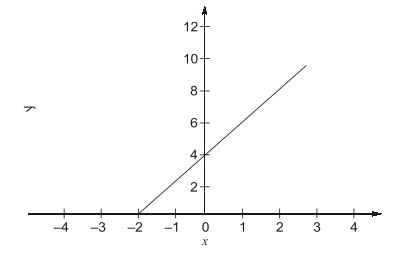
The real variables $x, y, z$ and the real constants $p, q, r $ satisfy
$\frac{x}{pq - r^2} = \frac{y}{qr - p^2} = \frac{z}{rp - q^2}$
Given the denominators are non-zero, the value of $px + qy + rz$ isConsider two matrices: $P = \begin{bmatrix} 1 & 2 \\ 0 & 1 \end{bmatrix}$ and $Q = \begin{bmatrix} 1 & 0 \\ 1 & 0 \end{bmatrix}$.
Which of the following statement is/are true?- $A^\alpha$ and $B_\beta$ ($\alpha, \beta = 1,2,3,\dots,n$) are contravariant and covariant vectors, respectively. By convention, any repeated indices are summed over. Which of the following expression is/are tensors?


