
Tensor Algebra Rules
Understanding tensor properties requires knowledge of how specific operations affect tensor rank and type. Key operations include:
- Outer Product: Combines tensors, increasing rank. E.g., rank (1,0) x rank (0,1) = rank (1,1).
- Contraction: Sums over matched indices (one upper, one lower), decreasing rank by 2. A complete contraction yields a scalar (rank 0).
- Addition: Only possible for tensors of identical rank and type.
Option 1: $A^\alpha B_\beta$ Tensor Analysis
This is the outer product of a contravariant vector $A^\alpha$ (type (1,0)) and a covariant vector $B_\beta$ (type (0,1)). The resulting object has type (1,0) + (0,1) = (1,1), which defines a tensor. Hence, $A^\alpha B_\beta$ is a tensor.
Option 2: $\frac{A^\alpha B_\beta}{A^\alpha B_\alpha}$ Tensor Analysis
The numerator $A^\alpha B_\beta$ is a tensor of type (1,1).
The denominator $A^\alpha B_\alpha$ represents a contraction. Summing over the index $\alpha$ between the contravariant $A^\alpha$ and covariant $B_\alpha$ results in a scalar (a tensor of type (0,0)).
Dividing a tensor by a scalar yields a tensor of the same type as the original tensor. Therefore, $\frac{A^\alpha B_\beta}{A^\alpha B_\alpha}$ is a tensor of type (1,1).
Option 3: $\frac{A^\alpha}{B_\beta}$ Tensor Analysis
This expression divides a contravariant vector $A^\alpha$ (type (1,0)) by a covariant vector $B_\beta$ (type (0,1)). Generally, dividing tensors component-wise does not produce a valid tensor transformation property. Since the vectors have different types, this operation is not defined as a tensor operation.
Option 4: $A^\alpha + B_\beta$ Tensor Analysis
This expression adds a contravariant vector $A^\alpha$ (type (1,0)) to a covariant vector $B_\beta$ (type (0,1)). Tensor addition requires the operands to have the exact same type and rank. As $A^\alpha$ and $B_\beta$ differ in type and rank, their sum is not a tensor.
Summary of Tensor Expressions
The expressions identified as tensors are $A^\alpha B_\beta$ and $\frac{A^\alpha B_\beta}{A^\alpha B_\alpha}$.
Important Questions from Algebra
- If $Pe^x = Qe^{-x}$ for all real values of $x$, which one of the following statements is true?
The relationship between two variables $x$ and $y$ is given by $x + py + q = 0$ and is shown in the figure. Find the values of $p$ and $q$.
Note: The figure shown is representative.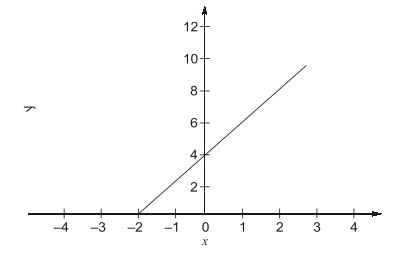
The real variables $x, y, z$ and the real constants $p, q, r $ satisfy
$\frac{x}{pq - r^2} = \frac{y}{qr - p^2} = \frac{z}{rp - q^2}$
Given the denominators are non-zero, the value of $px + qy + rz$ isThe complex function
$e^{-\left(\frac{2}{z-1}\right)}$
has __________________Consider two matrices: $P = \begin{bmatrix} 1 & 2 \\ 0 & 1 \end{bmatrix}$ and $Q = \begin{bmatrix} 1 & 0 \\ 1 & 0 \end{bmatrix}$.
Which of the following statement is/are true?


