
Consider two matrices: $P = \begin{bmatrix} 1 & 2 \\ 0 & 1 \end{bmatrix}$ and $Q = \begin{bmatrix} 1 & 0 \\ 1 & 0 \end{bmatrix}$.
Which of the following statement is/are true?
Analysis of Matrix Properties
Matrix Definitions
We are given two matrices:Matrix P: $P = \begin{bmatrix} 1 & 2 \\ 0 & 1 \end{bmatrix}$
Matrix Q: $Q = \begin{bmatrix} 1 & 0 \\ 1 & 0 \end{bmatrix}$
We need to evaluate the truthfulness of the given statements about these matrices.Eigenvalue Analysis (Statement A)
We find the eigenvalues for each matrix by solving the characteristic equation $\det(M - \lambda I) = 0$. For Matrix P: The characteristic equation is $\det \begin{bmatrix} 1-\lambda & 2 \\ 0 & 1-\lambda \end{bmatrix} = (1-\lambda)^2 = 0$. The eigenvalues are $\lambda=1$ with algebraic multiplicity 2. The set of eigenvalues is {1, 1}. For Matrix Q: The characteristic equation is $\det \begin{bmatrix} 1-\lambda & 0 \\ 1 & -\lambda \end{bmatrix} = (1-\lambda)(-\lambda) = 0$. The eigenvalues are $\lambda=0$ and $\lambda=1$. The set of eigenvalues is {0, 1}. Conclusion for Statement A: The set of eigenvalues for P is {1, 1} and for Q is {0, 1}. These sets are different. Therefore, Statement A is **False**.Commutation Check (Statement B)
Two matrices commute if their product is the same regardless of the order of multiplication, i.e., $PQ = QP$. Calculate PQ: $PQ = \begin{bmatrix} 1 & 2 \\ 0 & 1 \end{bmatrix} \begin{bmatrix} 1 & 0 \\ 1 & 0 \end{bmatrix} = \begin{bmatrix} (1)(1)+(2)(1) & (1)(0)+(2)(0) \\ (0)(1)+(1)(1) & (0)(0)+(1)(0) \end{bmatrix} = \begin{bmatrix} 3 & 0 \\ 1 & 0 \end{bmatrix}$ Calculate QP: $QP = \begin{bmatrix} 1 & 0 \\ 1 & 0 \end{bmatrix} \begin{bmatrix} 1 & 2 \\ 0 & 1 \end{bmatrix} = \begin{bmatrix} (1)(1)+(0)(0) & (1)(2)+(0)(1) \\ (1)(1)+(0)(0) & (1)(2)+(0)(1) \end{bmatrix} = \begin{bmatrix} 1 & 2 \\ 1 & 2 \end{bmatrix}$ Conclusion for Statement B: Since $PQ \neq QP$, the matrices P and Q do not commute. Therefore, Statement B is **False**.Eigenvector Analysis (Statement C)
We find the linearly independent (LI) eigenvectors for each matrix. For Matrix P: For the eigenvalue $\lambda=1$, we solve $(P - 1I)v = 0$: $\begin{bmatrix} 0 & 2 \\ 0 & 0 \end{bmatrix} \begin{bmatrix} x \\ y \end{bmatrix} = \begin{bmatrix} 0 \\ 0 \end{bmatrix}$ This implies $2y=0$, so $y=0$. $x$ is arbitrary (non-zero). The eigenvectors are of the form $k \begin{bmatrix} 1 \\ 0 \end{bmatrix}$. There is only one LI eigenvector, e.g., $v_P = \begin{bmatrix} 1 \\ 0 \end{bmatrix}$. For Matrix Q: For eigenvalue $\lambda=0$: $(Q - 0I)v = 0$: $\begin{bmatrix} 1 & 0 \\ 1 & 0 \end{bmatrix} \begin{bmatrix} x \\ y \end{bmatrix} = \begin{bmatrix} 0 \\ 0 \end{bmatrix}$ This implies $x=0$. $y$ is arbitrary (non-zero). Eigenvector $v_{Q1} = \begin{bmatrix} 0 \\ 1 \end{bmatrix}$. For eigenvalue $\lambda=1$: $(Q - 1I)v = 0$: $\begin{bmatrix} 0 & 0 \\ 1 & -1 \end{bmatrix} \begin{bmatrix} x \\ y \end{bmatrix} = \begin{bmatrix} 0 \\ 0 \end{bmatrix}$ This implies $x-y=0$, so $x=y$. $y$ is arbitrary (non-zero). Eigenvector $v_{Q2} = \begin{bmatrix} 1 \\ 1 \end{bmatrix}$. Matrix Q has two LI eigenvectors: $v_{Q1}$ and $v_{Q2}$. Conclusion for Statement C: Matrix P has one LI eigenvector, while Matrix Q has two LI eigenvectors. The sets of LI eigenvectors are different. Therefore, Statement C is **True**.Diagonalizability Check (Statement D)
A matrix is diagonalizable if the geometric multiplicity of each eigenvalue equals its algebraic multiplicity. For Matrix P: The eigenvalue $\lambda=1$ has algebraic multiplicity 2. The geometric multiplicity (number of LI eigenvectors) for $\lambda=1$ is 1. Since $1 \neq 2$, Matrix P is not diagonalizable. Conclusion for Statement D: Statement D, "P is diagonalizable", is **False**.True Statements Summary
Based on the analysis:- Statement A is False.
- Statement B is False.
- Statement C is True.
- Statement D is False.
Important Questions from Algebra
- If $Pe^x = Qe^{-x}$ for all real values of $x$, which one of the following statements is true?
The relationship between two variables $x$ and $y$ is given by $x + py + q = 0$ and is shown in the figure. Find the values of $p$ and $q$.
Note: The figure shown is representative.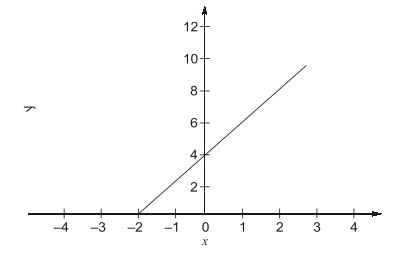
The real variables $x, y, z$ and the real constants $p, q, r $ satisfy
$\frac{x}{pq - r^2} = \frac{y}{qr - p^2} = \frac{z}{rp - q^2}$
Given the denominators are non-zero, the value of $px + qy + rz$ isThe complex function
$e^{-\left(\frac{2}{z-1}\right)}$
has __________________- $A^\alpha$ and $B_\beta$ ($\alpha, \beta = 1,2,3,\dots,n$) are contravariant and covariant vectors, respectively. By convention, any repeated indices are summed over. Which of the following expression is/are tensors?


