Beam Bending Moment Sign Change Implications
The relationship between the bending moment ($M$) and the curvature of a beam is fundamental in structural mechanics. For small deflections, the curvature is approximated by the second derivative of the deflection curve, $y$. The governing equation is:
$ \frac{d^2y}{dx^2} = \frac{M}{EI} $
Here:
- $ \frac{d^2y}{dx^2} $ represents the curvature.
- $ M $ is the bending moment.
- $ E $ is the Young's modulus of the beam material.
- $ I $ is the moment of inertia of the beam's cross-section.
Assuming $E$ and $I$ are positive constants (typical for homogeneous beams), the sign of the curvature $ \frac{d^2y}{dx^2} $ is directly dependent on the sign of the bending moment $ M $.
Curvature Changes Sign with Bending Moment
If the bending moment $ M $ at a point changes its sign, it must pass through zero at that point. Consequently, because the curvature $ \frac{d^2y}{dx^2} $ is directly proportional to $ M $, the curvature must also change its sign at that same point. This point is known as the point of contraflexure.
Analysis of Other Options
- Slope: The slope $ \frac{dy}{dx} $ is related to the integral of the bending moment ($ EI \frac{dy}{dx} = \int M dx $). While the slope reaches an extremum (maximum or minimum) where $ M = 0 $, it does not necessarily change sign itself.
- Deflection: Deflection $ y $ changes sign when the beam crosses its original unloaded position (neutral axis). This occurs at points of zero deflection, which are not necessarily the same points where the bending moment changes sign.
- Shear Force: The shear force $ V $ is related to the rate of change of bending moment ($ V = \frac{dM}{dx} $). Shear force changes sign where the bending moment is maximum or minimum, not where the bending moment itself changes sign.
Therefore, the only statement that is ALWAYS TRUE when the bending moment changes sign is that the curvature changes sign.
Important Questions from Analytical Aptitude
- The assumption that the probability of occurrence of a word in a string depends ONLY on the preceding word is called a ______ assumption.
- Which ONE of the following options represents the correct mapping of the phonetic features in Column X to their Sanskrit equivalents in Column Y?
Column X:
Phonetic featuresColumn Y:
Sanskrit termsP. voicing 1. prāṇa Q. retroflex 2. tālavya R. palatal 3. ghōṣa S. aspiration 4. mūrdhanya - Which ONE of the options represents the CORRECT mapping between the morphological concepts in Column X and the examples in Column Y?
Column X:
Morphological ConceptsColumn Y:
ExamplesP. Suppletion 1. bookmaker – bookie Q. Conversion 2. deer – deer R. Zero morpheme 3. bad – worst S. Hypocorism 4. arrive – arrival T. Derivation 5. (a) doctor – (to) doctor 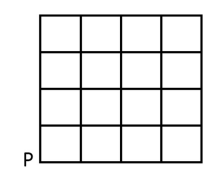
An ant is at the bottom-left corner of a grid (point P) as shown above. It aims to move to the top-right corner of the grid. The ant moves only along the lines marked in the grid such that the current distance to the top-right corner strictly decreases.
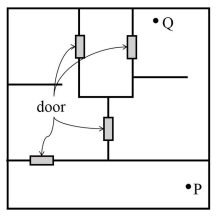
Which one of the following is a part of a possible trajectory of the ant during the movement?A building has several rooms and doors as shown in the top view of the building given below. The doors are closed initially.
What is the minimum number of doors that need to be opened in order to go from the point P to the point Q?