The angles of a triangle are 2x°, (3x−8)° and (5x−12)°. The greatest angle of the triangle is:
88°
The three angles are 2x, (3x-8), and (5x-12), and they sum to 180: 2x+3x-8+5x-12=180, giving 10x=200, x=20. The largest angle is 5x-12 = 100-12 = 88 degrees.
Similar Questions
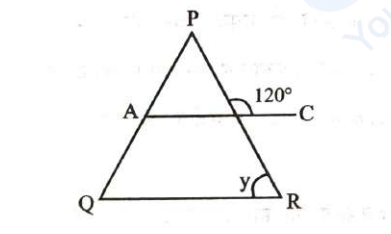
In the following figure is AC || QR, then Y = ?
Important Questions from Triangles
Among the following options, which are NOT sides of a triangle?
In a Δ ABC, if ∠A = 120° and AB = AC, then the values of ∠B and ∠C are respectively:
In the equilateral Δ ABC, the base BC is trisected at D and E. The line through D, Parallel to AB, meets AC at F and the line through E parallel to AC meets AB at G. If EG and DF intersect at H, then what is the ratio of the sum of the area of parallelogram AGHF and the area of the Δ DHE to the area of the Δ ABC?
The product of the perimeter of a triangle, the radius of its in‐circle, and a number gives the area of the triangle. The number is
A man goes 24 m towards east and then 10 m towards north. How far is he away from his initial position?